With the Starship launch on Monday marking a milestone for SpaceX, analysts at Citi believe the event is a major step toward unlocking the company’s broader valuation, including a long-term price target of $900 a share.
The target, set by Citi analysts led by John Godyn, would value SpaceX at roughly $12.2 trillion, more than twice Nvidia’s current market value, MarketWatch reported.
SpaceX (SPCX) is currently valued at around $2 trillion.
Citi said the successful 14th flight of Starship strengthened the investment case for SpaceX’s launch, satellite connectivity and artificial-intelligence businesses.
“We believe that SPCX’s unrivaled launch capabilities represent the foundational competitive advantage that enables all other parts of its business,” Godyn said in a note to clients, calling the latest Starship mission a “major” milestone.
Starship completes first orbital mission
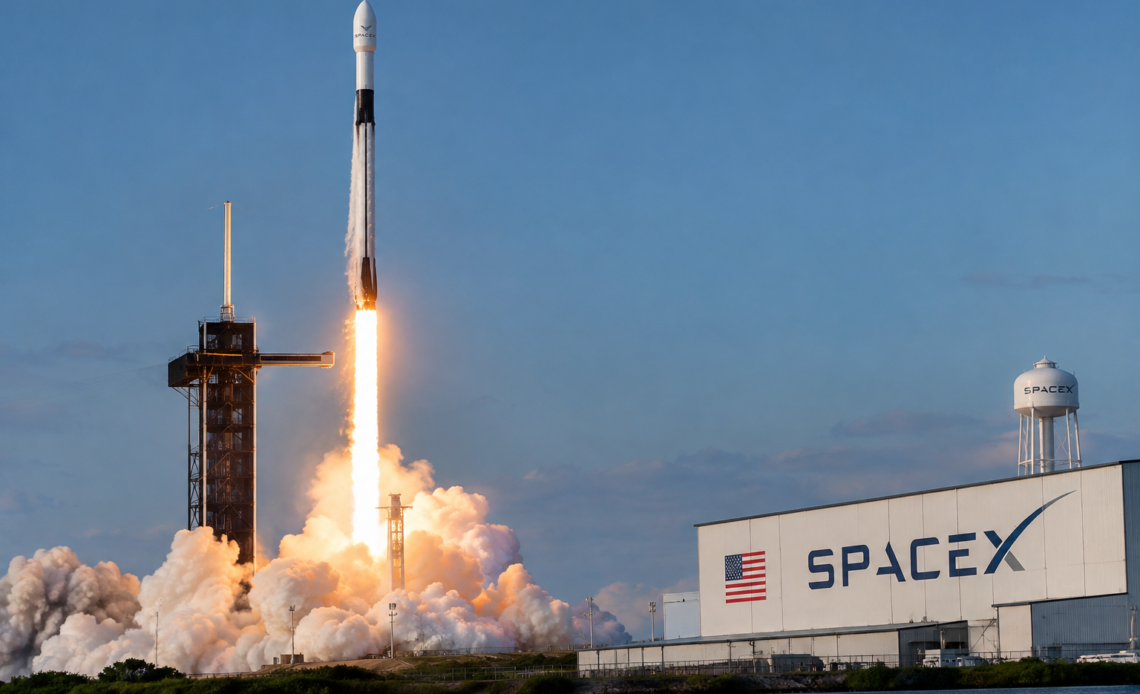
SpaceX launched Starship on Monday for the first time since July.
Despite an engine problem, the spacecraft reached orbit, marking a significant milestone for the company’s largest and most powerful rocket.
The mission also saw Starship deploy 26 Starlink V3 satellites, making it the vehicle’s first revenue-generating flight.
Citi said the ability to use Starship to deploy large numbers of advanced Starlink satellites, as well as future AI satellites, could become an important driver of SpaceX’s growth.
Godyn said the latest mission brings the company closer to “unlocking the full valuation” of its AI and connectivity operations.
Starship itself is not expected to generate most of SpaceX’s future revenue.
Instead, Citi sees the rocket as infrastructure that could enable other businesses by substantially increasing the number of satellites SpaceX can put into orbit.
“The successful deployment of Starship will establish the most affordable and scalable path to unlocking the economic potential of space,” Citi wrote in an earlier note to clients.
Citi sees revenue approaching $1 trillion
The bullish valuation assumes SpaceX will expand rapidly over the next several years.
Wall Street expects the company to generate about $44 billion in revenue and $21 billion in earnings before interest, tax, depreciation and amortization in 2026, according to FactSet data.
Citi expects a significantly larger business by 2030, forecasting $484 billion in revenue and $360 billion in EBITDA.
That compares with consensus estimates of $409 billion in revenue and $311 billion in EBITDA.
For 2031, Citi forecasts SpaceX revenue of about $1 trillion, broadly matching a prediction previously made by Chief Executive Officer Elon Musk.
Citi also has a $200 target for SpaceX shares by the end of this year.
Analysts focus on Starship reusability
The next major test could come on Starship’s next flight, which is expected before the end of the year.
UBS analyst John Hodulik said SpaceX could attempt to catch the vehicle using the launch tower’s “chopstick” arms.
Successfully recovering Starship would be an important step toward making the vehicle rapidly reusable.
Hodulik said combining the catch technology with SpaceX’s planned Louisiana spaceport could help the company “create a steady cadence of launches in 2027.”
He has a $210 price target for SpaceX.
RBC analyst Ken Herbert also viewed the latest launch positively and has a $225 target.
However, the flight was not without technical problems.
Deutsche Bank analyst Edison Yu said SpaceX still needs to determine the cause of the booster’s engine issues and investigate the early shutdown of one of Starship’s Raptor vacuum engines.
That failure nearly forced SpaceX to abandon its attempt to reach orbit, underscoring the engineering challenges that remain before Starship can support the high-frequency launch schedule envisioned by the company and its bullish analysts.
The post Why Citi thinks SpaceX stock could hit a $12 trillion valuation one day appeared first on Invezz