
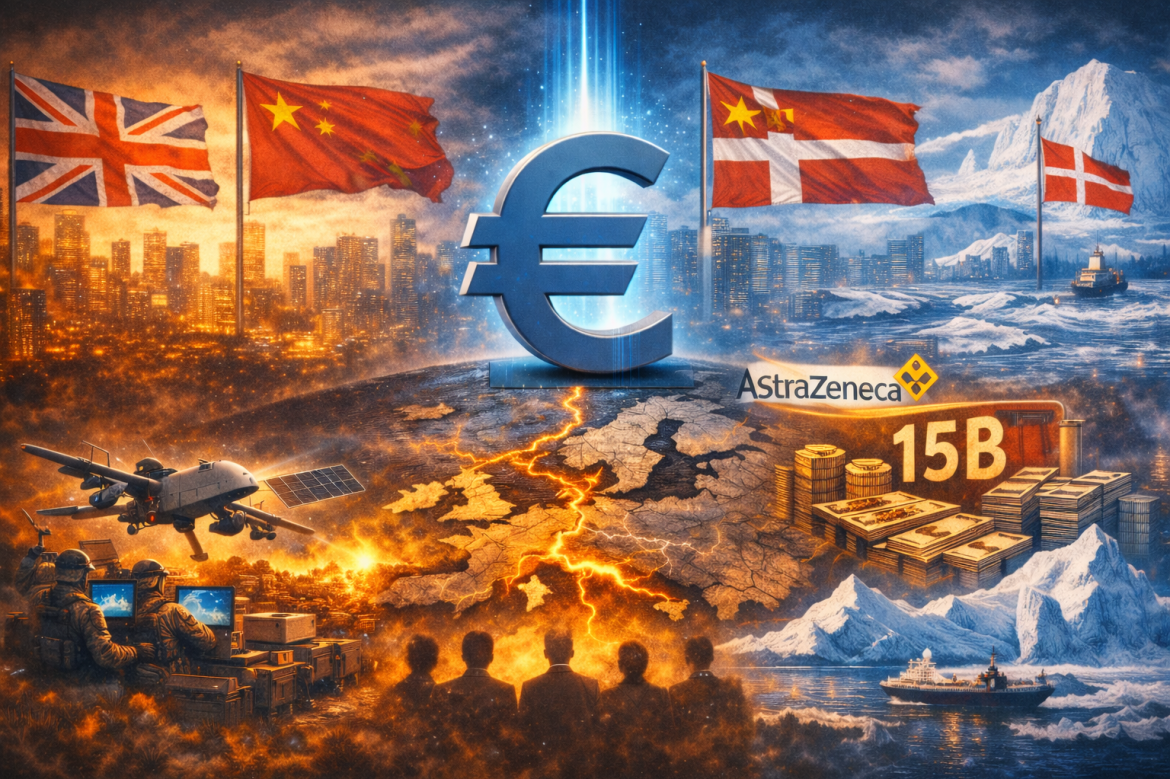
Europe bulletin: UK’s ‘long-term’ China play, war tech problems, AstraZeneca’s $15B bet
Europe is recalibrating, quietly but decisively.
From Keir Starmer’s pragmatic reset with Beijing, to the unintended battlefield consequences of Western tech in Ukraine, to Denmark’s symbolic show of sovereignty in the Arctic, the week underscores a continent hedging risk on multiple fronts.
Big money, fragile alliances, and uneasy geopolitics collide as Europe balances economics, security, and identity in a world where old assumptions no longer hold.
Starmer pitches economic pragmatism over politics
Prime Minister Keir Starmer wrapped up his Beijing summit with Xi Jinping, looking to flip the script on eight years of frosty relations.
The two leaders agreed to build a “long-term strategic partnership,” swapping diplomatic jabs for handshake opportunities.
Starmer brought 54 business executives to underscore the mission: unlock trade, not lectures about human rights.
The economic angle is hard to ignore; China sits as Britain’s fourth-largest trading partner at $137 billion.
Yet the visit carries political weight too. With Trump threatening tariffs and rattling geopolitical cages, Starmer is quietly hedging Britain’s bets, pivoting from Conservative skepticism to Labour pragmatism.
Both sides are pushing deals on small boat smuggling, AI collaboration, and investment.
Ukraine’s Starlink problem: Can’t win with Russia using it
Ukraine’s got a nightmare on its hands; the very tech keeping its military connected is now arming Russian drones.
Defense Minister Mykhailo Fedorov confirmed “hundreds” of Starlink-equipped Russian attacks on Ukrainian cities this month.
A 500-kilometer reach means most of Ukraine and chunks of NATO allies sit in the crosshairs.
The irony stings: SpaceX rushed Starlink to Ukraine in 2022 as a lifeline against Russian jamming. Now Moscow’s weaponized it. Fedorov immediately contacted Elon Musk, who apparently agreed to block Russian access.
But here’s the catch: you can’t exactly turn off a satellite. Starlink terminals are already in Russian hands, likely smuggled through third countries.
It’s a tech cat-and-mouse game with no clean solution, and civilians are paying the price.
AstraZeneca’s $15B China bet
AstraZeneca just threw down the biggest card on Starmer’s Beijing table, a whopping $15 billion through 2030 for Chinese manufacturing and R&D.
CEO Pascal Soriot wasn’t messing around: this is the Anglo-Swedish drugmaker’s largest China investment ever, signaling a hard pivot toward what the company calls its “second-largest market.”
The cash flows into cell therapy, radioconjugates, and expanded facilities in Wuxi, Taizhou, and Beijing.
Translation: AstraZeneca’s betting that China’s innovation engine rivals the West.
With over 17,000 employees already there, growing to 20,000-plus, the company’s essentially hedging geopolitical risk by anchoring deep into Beijing while simultaneously pledging $50 billion in the US.
It’s a calculated play to tap Chinese biotech talent, avoid Trump’s tariff friction, and lock in market share before regulatory walls climb higher.
Greenland morale mission
Denmark’s King Frederik X announced a February 18-20 trip to Greenland, delivering a timely political message as Trump continues his Arctic power play.
The symbolism cuts deep: Frederik’s arrival to lift spirits among Greenlanders rattled by months of US acquisition talk and online threats.
The island’s government just launched a mental health survey, unprecedented, citing Trump’s takeover rhetoric as fueling “insecurity and concern.”
Frederik said it plainly: “They’re worried, and I want to meet them.”
Prime Minister Jens-Frederik Nielsen doubled down, insisting Greenlanders would choose Denmark over the US if forced to pick.
While Trump softened his tone last week (backing away from military seizure), the damage lingers.
Frederik’s visit isn’t just royalty showing up; it’s Denmark asserting sovereignty when Arctic geopolitics are anything but quiet.
The post Europe bulletin: UK’s ‘long-term’ China play, war tech problems, AstraZeneca’s $15B bet appeared first on Invezz