Apple (NASDAQ: AAPL) shares reached an all-time intraday high of $345.34 on Tuesday before closing at $339.75, giving the company a market capitalization of approximately $4.96 trillion.
The stock briefly pushed Apple above the $5 trillion market-capitalization threshold during the session, according to Dow Jones Market Data.
Apple had previously touched the $5 trillion milestone during intraday trading on July 28 and July 29.
However, Nvidia (NASDAQ: NVDA) remains the only company to have closed a trading session above the $5 trillion mark.
The latest advance has pushed Apple shares up 25% this year, comfortably ahead of the roughly 10% gain for the Roundhill Magnificent Seven ETF and the 13.4% advance in the S&P 500.
The rally has accelerated since the company’s September product launch, with Apple shares gaining 7.2% since the beginning of the month.
Investors are now looking beyond the immediate reaction to the new products and assessing whether the iPhone 18 cycle can sustain Apple’s earnings momentum.
iPhone Duo creates a new growth opportunity
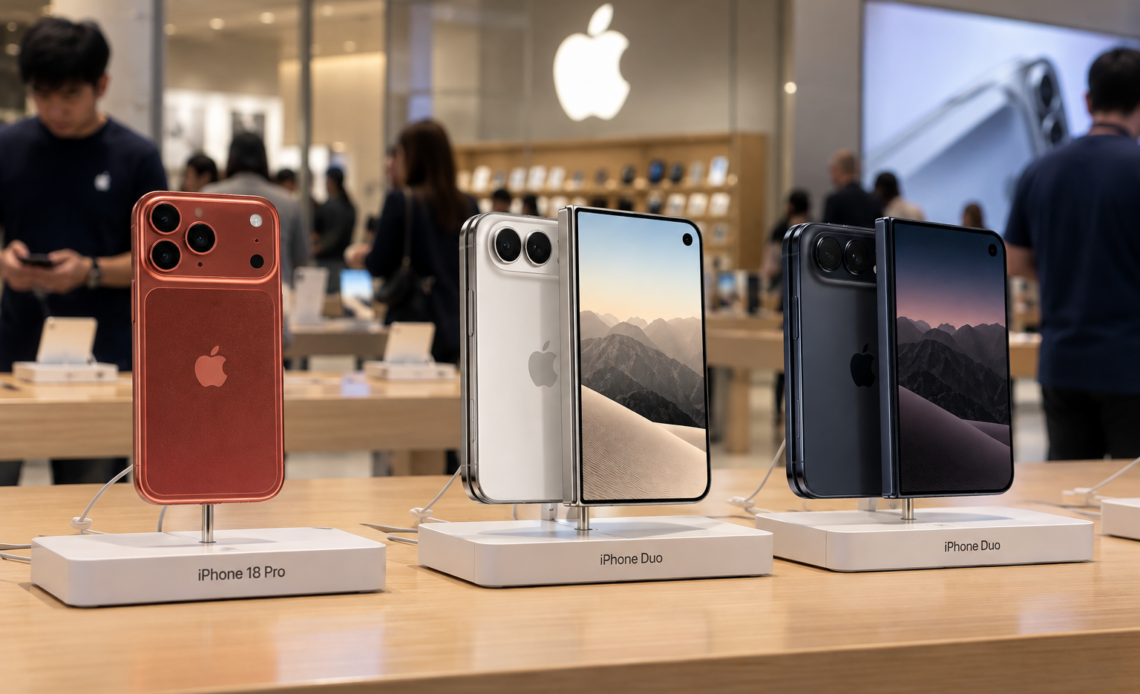
The biggest change in Apple’s latest product lineup is the introduction of the iPhone Duo, the company’s first foldable smartphone.
Alongside the Duo, Apple unveiled the iPhone 18 Pro and Pro Max under new CEO John Ternus and announced further Apple Intelligence updates through iOS 27 and macOS 27.
The foldable device gives Apple a new premium category at a time when the company is already looking to extract more revenue from its installed base.
Bank of America analyst Wamsi Mohan has a $370 price target on Apple, significantly above the approximately $342.60 share price that would correspond to a $5 trillion market capitalization.
“The Duo represents a meaningful form-factor change after a long time and seamlessly integrates hardware and software,” Mohan wrote in a note following the September 9 announcement.
JPMorgan analyst Samik Chatterjee also expects Apple to maintain a positive volume cycle despite higher prices, pointing to leasing arrangements, trade-ins and carrier subsidies as mechanisms that could help consumers absorb price increases.
The iPhone Duo’s “impressive display of features” could also create volume upside for Apple’s premium smartphone offering, Chatterjee wrote.
Citi has gone further in describing the product’s potential significance, calling the Duo “Apple’s biggest new hardware category since the watch and AirPods.”
The firm noted that Apple had already increased prices for the iPhone 16 and iPhone 17 by at least $100 to offset higher memory component costs.
Citi said pricing for the iPhone 18 range and foldable model was broadly consistent with its expectations.
Analysts see demand potentially exceeding supply
One of the most bullish arguments around the Duo is that Apple may initially struggle to manufacture enough devices to meet demand.
Evercore ISI analyst Amit Daryanani, who has a Buy rating and a $365 price target on Apple, expects early sales to be constrained by production rather than consumer appetite.
“This phone is going to sell as many units as Apple can produce, at least in the near term, the next 3 to 6 months,” Daryanani said earlier this month after the launch.
The potential scale becomes more significant when measured against Apple’s enormous installed base.
Daryanani estimates that if the Duo captures just 5% of Apple’s installed base, it could generate approximately $25 billion in revenue.
Apple could sell 7 million Duo sets
Deepwater Asset Management managing partner Gene Munster has also raised his expectations following the launch.
Expert view
Since the iPhone lineup was announced on September 9th, consensus iPhone revenue estimates for FY27 have come up by 3%, or $9.5B. While there are moving parts around the price increase and shifting mix, along with the reality that some analysts have yet to update their numbers, I believe the majority of the revisions are related to the addition of Duo revenue.
Munster estimates that if the additional $9.5 billion in projected iPhone revenue were attributed entirely to the Duo at an average selling price of $2,100, the current consensus would imply about 4.5 million units in fiscal 2027.
However, because only around half of analysts had updated their models in FactSet at the time of his analysis, Munster believes the actual Street expectation could be closer to 7 million units.
That compares with roughly 270 million iPhones that Apple is expected to sell next year.
Munster sees Duo contributing 14% of iPhone revenue
Munster believes even those higher estimates may underestimate the Duo’s potential.
“My take is the Street is too low for FY27 Duo. I believe a realistic view is that 35% of Pro Max users will make the move to Duo. That’s a big segment, considering I believe last year Pro and Pro Max accounted for 45% of the 270m iPhones sold. Basically, if a third of Pro Max users make the jump to Duo, that would increase overall iPhone revenue in FY27 by 10%, driven by the fact that ASP for Duo will be at least 60% higher than the average ASP of Pro and Pro Max,” Munster wrote.
“My bottom line: Duo is going to account for about 8% of units next year and 14% of iPhone revenue,” he said.
That forecast highlights why the foldable phone could have an outsized effect on Apple’s financial results even if it represents a relatively small portion of total iPhone shipments.
The higher average selling price also gives Apple an opportunity to grow revenue without relying entirely on expanding unit volumes.
Rick Munarriz of The Motley Fool similarly sees significant potential, provided Apple avoids major hardware problems.
Expert view
As long as the iPhone Duo doesn't launch next month with a major flaw — along the lines of those foldable screens cracking easily — Apple will sell a ton of these in fiscal 2027. Analysts already see Apple revenue climbing 10.5% next year. If so, it would be the first time since fiscal 2012 that Apple delivers back-to-back years of double-digit revenue growth. Now that would be a Duo worth unfolding
Apple’s AI strategy remains more measured
The iPhone launch also highlighted Apple’s approach to artificial intelligence.
The company unveiled the latest generation of Apple Intelligence, its AI platform integrated across iPhones, iPads, Macs, Apple Watches and Siri functionality.
Unlike some of its Big Tech peers, Apple has taken a comparatively measured approach to AI infrastructure spending.
While other companies are committing hundreds of billions of dollars to data centers and AI computing capacity, Apple is seeking to make AI a feature that strengthens its existing hardware and software ecosystem.
That strategy has allowed Apple to benefit from growing AI enthusiasm without assuming the same level of infrastructure spending and associated capital requirements.
For investors, the combination of Apple Intelligence and the Duo could therefore create two complementary growth avenues: AI-enhanced services and devices on one side, and a new premium hardware category on the other.
Memory costs remain a threat to margins
The bullish outlook nevertheless faces a significant near-term risk from rising memory costs.
Apple is dealing with a global memory crunch that is increasing component prices, creating pressure on the company’s margins even as it raises product prices.
Morningstar senior equity analyst William Kerwin expects Apple to be “sharing the pain” with consumers.
He forecasts margins to compress by around 1% in fiscal 2027 before recovering in 2028 as supply constraints ease.
Morningstar recently raised its fair value estimate for Apple to $290 from $285, reflecting slightly higher pricing assumptions.
That valuation remains well below Apple’s current share price.
The gap highlights the challenge facing Ternus as Apple approaches a $5 trillion valuation.
The company needs to demonstrate that consumers will continue paying more for its products while the Duo generates incremental demand, Apple Intelligence strengthens the ecosystem and margins withstand higher memory costs.
With analysts increasingly raising their expectations for the iPhone 18 cycle, the question for Apple stock is no longer simply whether the company can briefly cross $5 trillion.
It is whether the new product cycle can turn that milestone into a more durable earnings-growth story.
The post Apple stock flirts with $5T again: can iPhone Duo put it alongside Nvidia? appeared first on Invezz