Read the headline and IonQ looks like a company in crisis: a net loss of $1.87 billion in a single quarter on revenue of $80.1 million. That reading is wrong, and the reason it is wrong is the most important thing to understand about this stock. Of that loss, $1,649.1 million was a non-cash mark on warrant liabilities — a line that gets worse when IONQ shares go up. IonQ is structurally short its own equity. Shares closed at $40.34 on 17 September 2026, up 9.50% on the day, still 10.1% below where they started the year. This IonQ stock price prediction sets the bull case at $75, the base case at $48 and the bear case at $22 — and argues the real bear risk is not the loss everyone is quoting, but the gross margin nobody is.
Here is the synthesis. IonQ’s revenue grew 287% year over year in Q2 2026, from $20.7m to $80.1m. Over the same period cost of revenue grew from $8.3m to $60.1m. Do the division: gross margin fell from 59.8% to 24.9% while revenue nearly quadrupled. Those two numbers appear on consecutive lines of the same 8-K exhibit filed 5 August 2026, and I have not seen a single piece of coverage put them together. The mix has shifted from high-margin cloud access to low-margin hardware deployment and foundry work. That is not a scandal — it is what happens when a quantum company starts shipping physical systems. But it means “287% growth” and “IonQ is scaling” are not the same statement, and a stock at 65x trailing sales is priced as though they are.
Key facts: IonQ stock at a glance
- Spot: $40.34 close, 17 September 2026 (+9.50%) — stockanalysis.com, cross-checked against CNBC
- 52-week range: $25.89 (30 Mar 2026) to $84.64 (13 Oct 2025); down 10.1% year to date from $44.87
- Q2 2026 revenue: $80.05m, +287% YoY; H1 revenue $144.7m versus $28.3m — IonQ, 5 August 2026
- The loss, decomposed: operating loss $337.2m; warrant fair-value loss $1,649.1m; net loss attributable to IonQ $1,867.7m; adjusted EBITDA loss $120.3m
- Cash: $3.0bn at 30 June 2026, or $2.0bn pro-forma after the SkyWater acquisition closed on 31 July
- Balance-sheet composition: goodwill $2,186.0m plus intangibles $778.9m equals 43.7% of the $6,778.6m asset base
- Guidance: standalone 2026 revenue $280-290m; combined with SkyWater, $450-460m (8-K, 8 September 2026)
- Valuation: market cap ~$16.0bn on 397.3m shares — roughly 65x trailing sales, 35x the midpoint of combined 2026 guidance
What IonQ actually sells, and why the technology is the easy part
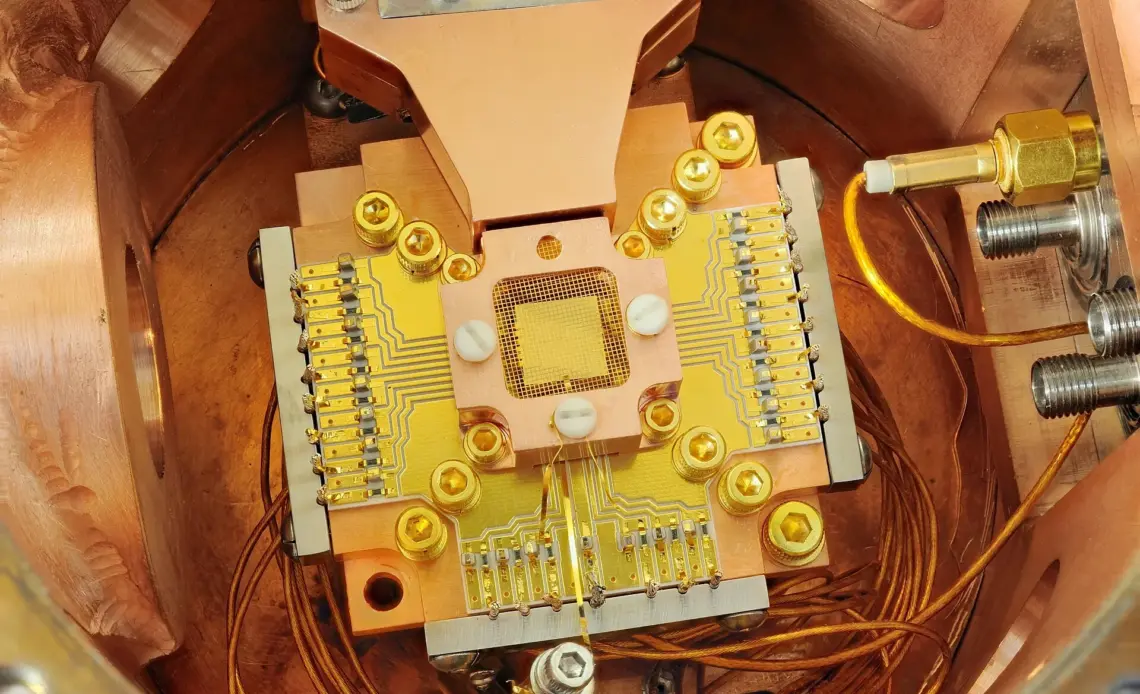
IonQ builds trapped-ion quantum computers. Individual ytterbium ions are suspended in an electromagnetic field inside an ultra-high-vacuum chamber and manipulated with lasers; each ion is a qubit. The advantage over the superconducting approach used by Rigetti and IBM is that every ion is identical and any pair can be entangled directly, which removes the routing overhead that limits gate depth on a fixed-lattice chip. The disadvantage is speed: gates are microseconds rather than nanoseconds. IonQ set a world record of 99.99% two-qubit gate fidelity in 2025.
The commercial story in 2026 is not really about ions, though. It is about acquisitions. Oxford Ionics brought ion-trap-on-chip fabrication. Nexus Photonics brought integrated photonics for miniaturisation. SkyWater Technology — closed 31 July 2026 — brought an actual US semiconductor foundry. Vector Atomic is intended for quantum sensing. Together they turned IonQ from a quantum-computing company into what it now calls “the world’s leading full-stack quantum platform and foundry.”
That repositioning is why the combined 2026 revenue guide jumped to $450-460m at the 8 September investor day while standalone guidance stayed at $280-290m. Roughly $170m of the top line is bought, not built. Chairman and CEO Niccolo de Masi framed it this way in the release: “Our updated full-year guidance highlights both the market traction of our quantum platform and the foundational manufacturing scale provided by SkyWater.” CFO and COO Inder Singh added that releasing the first combined guidance “demonstrates the immediate financial and operational strength of bringing IonQ and SkyWater together.”
The honest way to hold both facts at once: IonQ is the only quantum pure-play with a real revenue base, and a meaningful share of that base is a mature specialty foundry business that happens to sit inside a quantum wrapper.
The named partners — and the award IonQ did not get
IonQ’s counterparty list is genuinely institutional. In the second quarter it signed memoranda of understanding with Anduril for defence and national-security applications and with Sandia National Laboratories for quantum co-design. It announced the Tennessee Quantum Communications Research Center with EPB, housing what it describes as the first commercial quantum memory unit installed in a live fibre network. It expanded its on-orbit optical communications terminals to 84 in support of a US government initiative.
On 16 September — the catalyst behind the 9.50% move the next session — IonQ published joint research with Oak Ridge National Laboratory, NVIDIA and the University of Tennessee, Knoxville, showing that a trained generative model (DQAOA-GPT) can write quantum optimisation circuits directly, replacing the iterative variational parameter tuning that made the most accurate approach too expensive to run. Every circuit in the study was simulated with NVIDIA’s cuQuantum SDK through the CUDA-Q platform on a single H200 GPU in Oak Ridge’s Defiant2 system. The paper was one of nine IonQ submissions accepted at IEEE Quantum Week 2026 in Toronto and won a best-paper award.
Note what that result actually is: a classical GPU model making quantum circuits cheaper to design. It is a strong research outcome and a weak revenue event, and the market paid 9.5% for it anyway — which tells you rather a lot about how this sector is being traded.
The omission matters more. In September 2026 the US Commerce Department finalised CHIPS Act research awards that hand Washington non-controlling equity stakes in quantum firms: Rigetti, D-Wave and Quantinuum each signed deals worth up to $100m, building on a $2.013bn framework across nine companies announced in May. IonQ was not among them. De Masi welcomed the White House quantum executive orders in August, saying they “send a strong signal that quantum sensing, quantum networking, quantum cybersecurity and quantum computing leadership are all now national priorities.” Being outside the equity programme cuts both ways: no dilution to the government, but also no federal balance-sheet endorsement at a moment when that endorsement is moving share prices.
The valuation maths
At $40.34 and 397.3 million shares, IonQ is a $16.0bn company. Against the $455m midpoint of combined 2026 guidance that is 35x forward sales. Against the $246.5m trailing twelve-month figure it is 65x. For context, the richest large-cap names in the AI supply chain trade in the high single digits to low teens on forward sales; our Applied Materials analysis and Marvell analysis both sit inside that range. IonQ is priced at three to five times the multiple of companies with actual profits.
The cash position is the genuine support. $2.0bn pro-forma against an adjusted EBITDA burn of $120.3m in the quarter implies roughly four years of runway at the current rate — before any SkyWater contribution. That is real, and it is why the bear case is $22 rather than a low single digit. But note what sits under the $6.78bn asset base: $2.19bn of goodwill and $0.78bn of intangibles, 43.7% of total assets, created by the acquisition programme. If quantum sentiment reverses and IonQ has to write any of that down, the balance sheet shrinks fast even though the cash does not move.
| Scenario | Level | vs $40.34 spot | What has to be true |
|---|---|---|---|
| Bull | $75 | +85.9% | Superion 256-qubit systems ship to customers on schedule in early 2027; combined revenue beats $460m; gross margin recovers above 40% as cloud and software mix returns; sector multiple re-expands toward October 2025 levels |
| Base | $48 | +19.0% | Combined 2026 lands inside the $450-460m guide, 2027 organic growth halves to ~50%, multiple holds near 30x forward sales |
| Bear | $22 | −45.5% | Gross margin stays in the twenties, 2027 guidance disappoints, goodwill is tested, and the quantum basket de-rates — taking IONQ below its $25.89 March low |
Quick take: analysts are clustered near the base case and above. Mizuho’s Vijay Rakesh cut his target to $52 from $61 while keeping a Buy; Jefferies raised to $80 from $75 after the investor day; B. Riley’s Craig Ellis reiterated Buy at $100. The consensus across 12 analysts polled by S&P Global is roughly $69.25 — between our base and bull levels, and a reminder that sell-side quantum coverage is uniformly constructive.
The warrant mechanism, and why GAAP will keep lying about IonQ
This deserves its own section because it will recur every quarter. IonQ carries warrant liabilities that are marked to fair value through the income statement. When IONQ’s share price rises, the warrants become more valuable to their holders and more expensive to IonQ, producing a loss. In Q2 2026 that mark was $1,649.1m — against an operating loss of $337.2m. It is non-cash. It does not consume runway. It does not reflect the business.
It does two harmful things anyway. First, it makes headline EPS useless: $(5.08) for the quarter, against an adjusted $(0.33). Second, it inverts the signal. A strong quarter in which the stock rallies will print a larger GAAP loss than a weak one in which it falls. FinanceFeeds flagged the identical trap at Intel, where the mark-to-market on shares owed to the US government grows as the stock rises — see our Intel price prediction. Any IonQ analysis that leads with the $1.87bn number without decomposing it is not analysis. Use adjusted EBITDA and the cash line instead.
Policy tension: national priority, no federal equity
Quantum policy in 2026 has moved decisively from grants to ownership. Commerce’s $2.013bn framework, announced in May and finalised through September, gives the government non-controlling equity in exchange for research funding — Atom Computing, D-Wave, Infleqtion, PsiQuantum and Quantinuum at $100m each, Rigetti up to $100m, Diraq $38m. The structure imports an industrial-policy model from the semiconductor and critical-minerals playbook into a pre-revenue research sector.
IonQ’s position outside that programme is defensible — it has $2bn of its own cash and does not need $100m — but it creates an asymmetry worth pricing. Government equity holders have an interest in the value of their stakes, and the political economy of the CHIPS programme has historically favoured recipients in procurement. IonQ’s counter is defence and national-security engagement through Anduril and Sandia, plus 84 on-orbit optical terminals supporting a US government initiative. Watch whether that converts into prime contracts. If it does, the omission from the equity programme becomes irrelevant. If it does not, IonQ is the largest quantum company without a federal seat at the table.
What happens next: three predictions
1. Gross margin is the Q3 print that moves the stock, not revenue. Revenue will land — the guide is combined, SkyWater’s contribution is contracted foundry work and remaining performance obligations grew 297% year over year. The uncertainty is mix. If Q3 gross margin recovers above 35%, the 287% growth story survives intact and $48-55 is the trading range into year-end. If it prints in the twenties again, the market will start treating IonQ’s revenue as foundry revenue with a quantum multiple attached, and the $22 level becomes live. Results are due in early November 2026.
2. Superion slips before it ships. IonQ’s roadmap targets initial 256-qubit customer deployments in early 2027 and a longer path to millions of qubits via integrated electronic qubit control. Every quantum hardware roadmap in the industry’s history has slipped at least one quarter; IonQ’s own 256-qubit demonstration timeline already moved once. A slip is not fatal — it is expected — but a slip disclosed alongside soft margin would be the single most likely trigger for a re-test of the March low.
3. The quantum basket decouples in 2027, and IonQ is the one that benefits. Right now IONQ, Rigetti, D-Wave and Quantum Computing Inc. trade as one instrument: on 17 September all four rallied together on an IonQ research paper. That correlation is a function of the sector having no revenue to differentiate on. IonQ’s trailing revenue is $246.5m; Rigetti’s is $13.4m. Once quantum names are valued on revenue rather than narrative — which combined guidance of $450-460m starts to force — dispersion arrives, and the company with 18 times its nearest listed peer’s revenue is the one that keeps a premium multiple. That is the strongest structural argument for the bull case, and it does not depend on a single qubit working better than it does today.
For the other side of the basket trade, see our D-Wave price prediction and our explainer on whether quantum computing can actually break Bitcoin.
FAQ
What is the IonQ stock price prediction for 2026?
This analysis sets a bull case of $75, a base case of $48 and a bear case of $22 against the 17 September 2026 close of $40.34. The bull level sits just under the October 2025 high of $84.64 and requires gross margin recovery plus on-schedule Superion deployments. Consensus across 12 analysts polled by S&P Global is about $69.25, with individual targets ranging from Mizuho’s $52 to B. Riley’s $100.
Why did IonQ report a $1.87 billion loss on $80 million of revenue?
Because $1,649.1m of the loss was a non-cash change in the fair value of warrant liabilities, not an operating cost. IonQ’s operating loss for the quarter was $337.2m and its adjusted EBITDA loss was $120.3m. The warrant mark increases when IONQ’s share price rises, so a strong quarter can produce a larger headline loss than a weak one. Adjusted EBITDA and the cash balance are the useful figures.
How much cash does IonQ have?
$3.0bn in cash, cash equivalents and investments as of 30 June 2026, or approximately $2.0bn pro-forma for the cash consumed in closing the SkyWater Technology acquisition on 31 July 2026. Against an adjusted EBITDA burn of $120.3m in Q2, that implies roughly four years of runway before any operating improvement or SkyWater contribution.
Is IonQ’s revenue growth organic?
Partly. Management reiterated confidence in 100% organic growth year on year for 2026 and guided standalone revenue to $280-290m. The jump to combined guidance of $450-460m reflects SkyWater’s contribution from 31 July onward, after intercompany eliminations — so roughly $170m of the combined figure is acquired rather than organic. The 287% headline growth rate in Q2 is a standalone organic number.
Did IonQ receive CHIPS Act funding?
No. The Commerce Department’s quantum awards — up to $100m each for Rigetti, D-Wave and Quantinuum, within a $2.013bn framework covering nine companies — did not include IonQ. Those awards give the US government non-controlling equity stakes in the recipients. IonQ’s federal exposure runs through research and defence relationships instead, including memoranda of understanding with Anduril and Sandia National Laboratories.
What is Superion?
Superion is the quantum-computing roadmap IonQ unveiled at its 8 September 2026 investor day, targeting initial 256-qubit customer deployments in early 2027 and a longer-term path from hundreds to millions of qubits using integrated electronic qubit control — the ion-trap-on-chip approach that came in with the Oxford Ionics acquisition.
This article is editorial analysis and market commentary, not investment advice. Scenario levels are FinanceFeeds estimates and are not price targets. Figures are as of the 17 September 2026 close unless stated otherwise.