
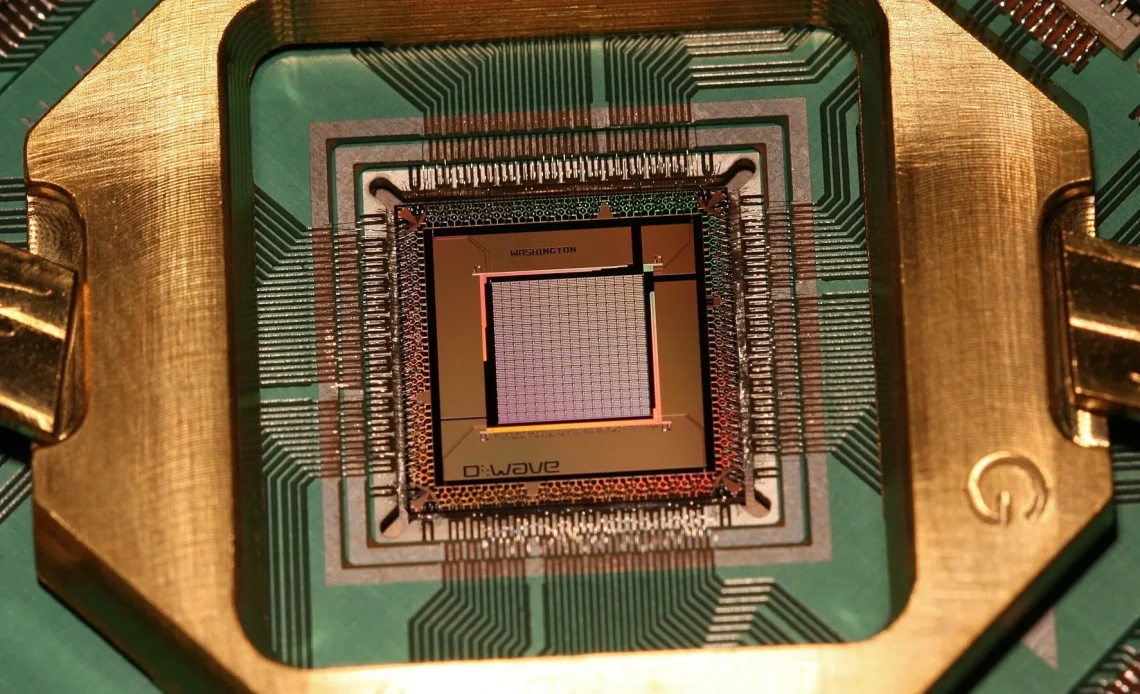
D-Wave Quantum is not expensive because the market is excited about quantum computing. It is expensive because of arithmetic that almost nobody quotes. QBTS trades at $18.68 as of 24 August 2026, carrying a market capitalisation of $6.96bn against trailing twelve-month revenue of $12.43m. That is roughly 560 times sales. And the denominator is not growing — trailing revenue is down 44.2% year on year. A bull case at $35 needs 87% upside and happens to sit exactly on the analyst consensus target of $35.25. A bear case at $9 needs a 52% decline, and even there the company would still trade near 270 times sales.
The detail that reframes the whole story is buried in D-Wave’s own second-quarter release. The company reported first-half bookings of $35.5m, a 1,120% year-on-year increase — a genuinely spectacular headline. It also reported Q2 bookings of $2.1m. Subtract one from the other and roughly $33.4m of that first-half total landed in Q1, meaning bookings fell about 94% sequentially into the June quarter. The 1,120% figure is accurate and it is the number that travelled; the sequential collapse underneath it is the number that matters for anyone modelling the next four quarters. This is a lumpy, system-sale business being presented with a growth-company frame.
Key facts
- QBTS: $18.68, down 8.39% on the session — StockAnalysis, close of 24 August 2026
- Market cap $6.96bn on $12.43m trailing revenue — about 560x sales — StockAnalysis, 25 August 2026
- Trailing revenue down 44.2% year on year; net income −$248.70m; EPS −$0.69 — StockAnalysis, 25 August 2026
- Q2 2026 revenue $3.1m against a $4.04m consensus, with bookings of $2.1m — D-Wave, 6 August 2026
- Cash and marketable securities of $546.2m against an adjusted EBITDA loss of $37.1m in the quarter — D-Wave, 30 June 2026
- Analyst consensus: Strong Buy, $35.25 target, implying 88.7% upside — StockAnalysis, 25 August 2026
- 58.3% below the $44.78 closing peak of 15 October 2025, and 43.9% above the $12.98 low of 30 March 2026 — StockAnalysis daily closes
Where the stock is, and what the last year did to it
QBTS peaked at $44.78 on 15 October 2025 and has spent the ten months since giving most of it back. The low came on 30 March 2026 at $12.98. The stock is up 20.9% from where it sat a year ago, and down 58.3% from the October high — both facts are true, and which one you lead with tends to determine your conclusion.
The important structural point on that chart is that the stock has not made a higher high since October 2025, and the rally into the 6 August results failed almost immediately. QBTS closed at $19.41 on the day of the print and is now $18.68, having dropped 8.39% in the most recent session alone. Volatility is not incidental here — the shares carry a beta of 2.16, so roughly twice the market’s move in either direction.
FinanceFeeds covered the two events that framed this window. The company moved to Nasdaq on 27 July, a listing upgrade that is a genuine positive for index eligibility and institutional access. Then came Q2, with $3.01m of revenue and bookings down to $2.1m, against options pricing that had implied a much larger move. The uplisting was the good news; the quarter was not.
What the company said, and what the numbers say back
Announcing the quarter on 6 August 2026, CEO Dr. Alan Baratz said the period “reinforced the strength and breadth of D-Wave’s leadership.” On technology, that is a defensible claim — D-Wave remains the only company selling commercial quantum annealing systems at scale, and it published a multi-year roadmap alongside the results: a 17-physical-qubit gate-model system in 2026, a 20,000-qubit annealing system by 2029, and 100,000 qubits targeted for 2031.
The tension is that none of those milestones fall inside the window that a 560x sales multiple has to be defended over. The 2029 system is three years away. The 2031 target is five. Meanwhile the revenue line has gone backwards, and the company’s own Q2 revenue of $3.1m came in nearly a million dollars below what analysts modelled.
The balance sheet is the strongest card in the bull hand, and it is a genuinely strong one. D-Wave held $546.2m in cash and marketable securities at 30 June 2026 against a quarterly adjusted EBITDA loss of $37.1m. That is roughly fifteen quarters of runway at the current burn — close to four years — which means dilution risk is low and the company is not obliged to raise into a weak tape. Put differently, D-Wave’s cash pile is about 44 times its annual revenue. Very few pre-revenue-scale companies get to wait this long for their market to arrive.
Sector sentiment has been volatile in both directions. FinanceFeeds noted in late July that a SEALSQ uplisting claim was stale even as quantum stocks rallied, which is a fair summary of how this cohort trades: headline-driven, correlated, and frequently detached from the specific company named in the headline. Retail attention has also been pulled toward the adjacent question of whether quantum computing can actually break Bitcoin — a debate that drives sector flows without generating a dollar of D-Wave revenue.
Pricing the two cases honestly
Here is what each scenario requires, expressed in the only terms that constrain a company at this valuation — the multiple it would carry if it got there.
| Scenario | Price | Move from $18.68 | Implied market cap | Multiple on $12.43m TTM revenue |
|---|---|---|---|---|
| Bull case | $35 | +87.4% | ~$13.0bn | ~1,049x |
| Analyst consensus target | $35.25 | +88.7% | ~$13.1bn | ~1,056x |
| Today | $18.68 | — | $6.96bn | ~560x |
| 52-week low close | $12.98 | −30.5% | ~$4.8bn | ~389x |
| Bear case | $9 | −51.8% | ~$3.4bn | ~270x |
That table is the single most useful thing in this article, because it makes both cases uncomfortable in a way the usual framing hides. The bull case is not “D-Wave gets re-rated to a reasonable multiple.” It is D-Wave doubling to roughly a thousand times sales. The consensus Strong Buy rating and $35.25 target are, arithmetically, a call that the multiple should nearly double from an already extreme level. That can only be justified by expected revenue that does not yet exist — which is a legitimate thesis for a technology at this stage, but it should be stated as such rather than dressed as valuation support.
Equally, the bear case is not a disaster scenario. A 52% decline to $9 still leaves D-Wave at about 270 times trailing sales and roughly $3.4bn of market value — a rich price for a company generating $3.1m a quarter. The honest read is that there is no price in this range at which QBTS is cheap on current fundamentals. The entire debate is about which future you are underwriting and how long your patience lasts.
For contrast on how a hardware story looks once revenue actually arrives, FinanceFeeds’ Super Micro bull-versus-bear breakdown covers a company whose multiple is argued in single digits rather than triple. That is the gap D-Wave has to close, and the roadmap says it closes no earlier than 2029.
The structural risk nobody prices: lumpiness
The deepest problem with valuing D-Wave is not the multiple. It is that the revenue line is close to unforecastable at this scale.
A business doing $3.1m in a quarter, where a single system sale can represent a material share of the year, does not have a revenue trend — it has a sequence of events. That is precisely what the bookings data showed: roughly $33.4m in Q1 and $2.1m in Q2. Analysts modelling Q4 2026 currently expect around $31.3m of revenue against roughly $4.3m for Q3, which tells you the sell side is also assuming a large, discrete system sale lands in the fourth quarter. If it slips a quarter — a routine occurrence in enterprise and government procurement — the reported growth rate inverts, even though nothing about the business has changed.
The miss record sharpens the point. D-Wave has now come in below consensus in both reported quarters of 2026: Q1 revenue of $2.86m against a $4.31m estimate, a 33.7% shortfall, then Q2’s $3.08m against $4.04m, a 23.9% shortfall. First-half revenue therefore totalled roughly $5.93m. Against that, the full-year consensus implied by quarterly estimates is about $41.5m — which means roughly 75% of the entire year’s expected revenue is assumed to arrive in the fourth quarter alone. The Q4 estimate of $31.3m is more than seven times the Q3 estimate and over ten times what the company actually booked in revenue last quarter. That is not a forecast with a margin of safety in it.
This is the mechanism by which a stock like QBTS falls 8% in a session on no company-specific news. Positioning is built on a forecast that hinges on the timing of a handful of contracts, so every macro wobble or sector headline forces a re-underwriting of a thesis that has almost no quarterly ballast beneath it.
It is worth stating the bull case at full strength rather than caricaturing it. D-Wave has $546.2m of cash, a Nasdaq listing, the only commercially deployed annealing fleet in the world, a published roadmap through 2031, and a sell side that is unanimously positive. If quantum optimisation crosses into mainstream enterprise procurement within three years, revenue does not grow 30% — it grows by multiples, and a 560x multiple on today’s tiny base stops being the relevant frame entirely. That is the actual argument, and it is not a stupid one. It is simply a venture-stage bet being priced in public markets with a $6.96bn valuation attached.
What happens next
One: Q3 on 5 November is a low bar that still matters. Consensus sits near $4.3m of revenue. Given Q2 came in at $3.1m against a $4.04m estimate, another miss would make it two in a row and would put the $12.98 March low back in play well before the $9 bear case. Watch bookings more closely than revenue — bookings are the leading indicator and they are the number that collapsed sequentially.
Two: the Q4 print in February is the real event. The roughly $31.3m consensus for Q4 2026 is the entire growth story compressed into one quarter. If that system sale lands, the trailing multiple compresses sharply and the bull case gets its first genuine support in a year. If it slips, the stock is left defending 560x sales on a revenue line that has fallen 44%, and the bear case stops being theoretical.
Three: expect the analyst target and the price to keep diverging. A Strong Buy consensus at $35.25 against a stock at $18.68 is an 88.7% gap. Gaps that wide usually close by the target coming down rather than the price going up, because targets are anchored to models that assume the Q4 sale and the 2029 roadmap arrive on schedule. A target cut is the more likely near-term catalyst, and it would be a sentiment event rather than a fundamental one.
The practical framing for anyone sizing this: QBTS is not a valuation trade in either direction. At $35 it is a thousand times sales and at $9 it is still 270 times, so no entry point in this range is defensible on current numbers. It is a timing bet on when enterprise quantum procurement becomes routine, funded by a balance sheet good for about four more years of waiting. Size it like the venture position it is, not like a stock with a multiple you can argue about.
Frequently asked questions
What is the D-Wave QBTS stock prediction for 2026?
The bull case is $35, which matches the analyst consensus target of $35.25 and implies 87% upside from $18.68. The bear case is $9, a 52% decline. The nearest catalysts are Q3 results on 5 November 2026 and the Q4 print in February 2027, where consensus assumes roughly $31.3m of revenue in a single quarter.
Why is D-Wave stock so expensive relative to revenue?
D-Wave carries a $6.96bn market capitalisation against $12.43m of trailing twelve-month revenue, roughly 560 times sales, and that revenue is down 44.2% year on year. The valuation reflects expected future quantum computing demand rather than current financial performance. Even at the $9 bear case the company would trade near 270 times sales.
Is D-Wave at risk of running out of money?
Not in the near term. D-Wave held $546.2m in cash and marketable securities at 30 June 2026 against an adjusted EBITDA loss of $37.1m for the quarter, which is roughly fifteen quarters — close to four years — of runway at the current burn rate. Dilution risk is correspondingly low.
What did D-Wave’s Q2 2026 results actually show?
Revenue of $3.1m against a $4.04m consensus, bookings of $2.1m, an adjusted EBITDA loss of $37.1m, and a GAAP loss of $0.13 per share. The company highlighted first-half bookings of $35.5m, up 1,120% year on year, but since Q2 bookings were only $2.1m, roughly $33.4m of that total came in the first quarter.
What would invalidate the bull case for QBTS?
A second consecutive revenue miss at the 5 November Q3 print, or slippage of the large fourth-quarter system sale that consensus assumes. Either would leave the stock defending an extreme multiple on a shrinking revenue base and would likely trigger analyst target cuts, putting the $12.98 March 2026 low back in play ahead of the $9 bear case.
Is D-Wave a good long-term investment?
That depends entirely on whether enterprise quantum optimisation becomes routine procurement within the next three to five years, which no current financial metric can answer. D-Wave’s roadmap targets a 20,000-qubit annealing system in 2029 and 100,000 qubits in 2031. This is a venture-stage bet trading at a $6.96bn public valuation, and it should be sized accordingly. This article is analysis, not investment advice.