THEA has raised $8 million in strategic funding to expand its predictive behavioral AI infrastructure and build a Solana-based coordination layer for real-time risk markets.
The round was led by Maven11 Capital, Spartan Group, ManifoldTrading, HackVC and Fisher8 Capital, according to company and market reports. THEA said the capital will be used to scale its operational AI systems and develop THEA Network, an on-chain coordination layer designed to route inference requests, manage accounting and settle transactions on Solana while keeping heavy computation off-chain.
Founded in 2024 and based in the Cayman Islands, THEA describes itself as a predictive behavioral AI network focused on high-volatility environments where decisions carry immediate economic consequences. The company says its AI models are trained on more than 35 billion real-world decision data points and that its applications process more than 400 million inference queries a month across more than 30 jurisdictions. Crypto Briefing reported that THEA serves over 3,000 enterprise customers, while some summaries put the figure at more than 3,500.
THEA’s core business is predictive behavioral intelligence for risk markets. Its models analyze how users, markets and counterparties behave under stress, then generate real-time predictions that clients can use for risk scoring, retention, liquidity management or operational decision-making. The company has said some clients have seen customer-retention improvements of up to 30% using its systems.
Hybrid AI Infrastructure Moves Onchain
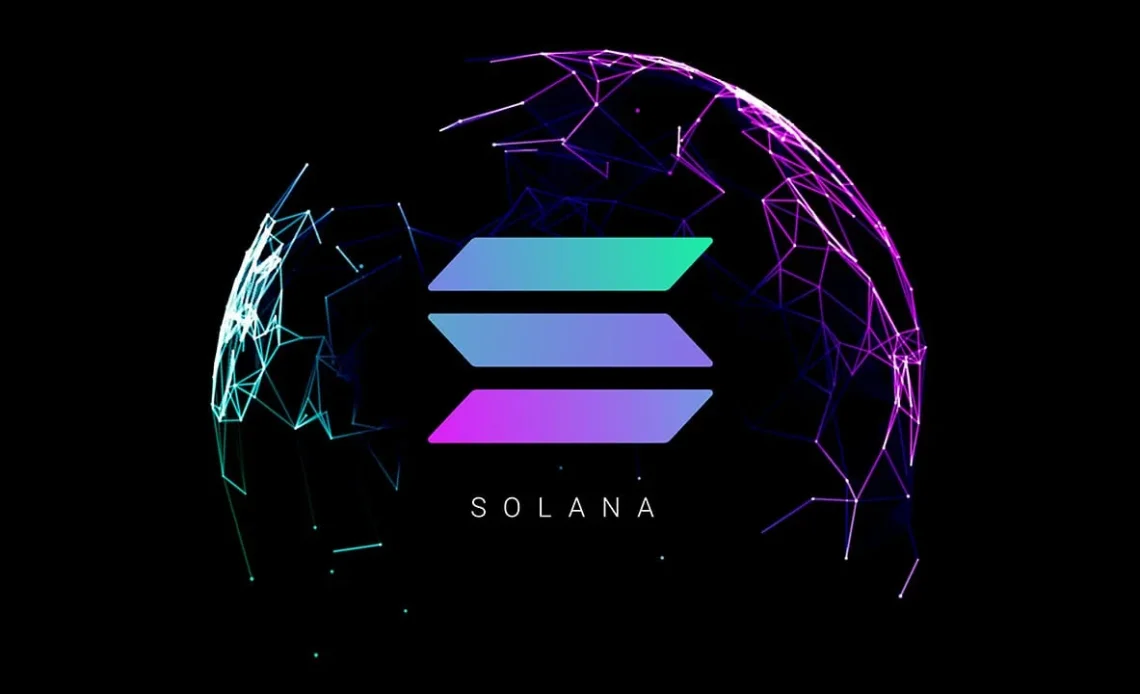
THEA’s planned Solana layer reflects a growing trend in AI-crypto infrastructure: using blockchains for coordination, settlement and incentives rather than attempting to run large AI computation directly on-chain.
In practice, THEA Network is expected to coordinate requests and economic flows, while the actual inference and data processing remain off-chain. That design matters because AI workloads are computationally intensive and unsuitable for most smart-contract environments. A hybrid architecture can use blockchain rails for transparent settlement, access control, payments or auditability without forcing models to execute inside the blockchain itself.
Solana’s role is tied to throughput and cost. A network handling hundreds of millions of monthly inference requests needs low-latency infrastructure if it wants to coordinate payments, permissions or usage accounting at scale. Solana’s high-speed settlement environment makes it a natural target for projects trying to connect AI agents, data services and financial applications.
THEA has also signaled plans to introduce a utility token that would tokenize access to its autonomous systems. If implemented, that could turn the network into a tokenized access and settlement layer for AI services, although the details of token economics, governance, eligibility and regulatory structure have not yet been disclosed.
Funding Signals AI-Crypto Convergence
The investor lineup shows continued venture interest in the intersection of AI, crypto infrastructure and real-world business workflows. Unlike purely speculative AI-token projects, THEA is positioning itself around enterprise risk markets, where predictive systems can be tied to measurable outcomes such as fraud reduction, customer retention, pricing, liquidity and risk control.
That gives the project a clearer commercial narrative, but execution risk remains high. THEA must prove that a Solana-based coordination layer improves performance, transparency or monetization compared with conventional cloud infrastructure. It must also show that tokenizing access to AI systems creates real utility rather than unnecessary complexity.
Regulatory questions will also matter. A network serving clients across more than 30 jurisdictions and operating in risk markets may face scrutiny around data use, automated decision-making, financial-risk modeling and token distribution. If THEA’s systems influence credit, trading, insurance, gaming, prediction or other high-stakes decisions, transparency and compliance will become central to adoption.
The broader market impact is that AI infrastructure is becoming one of the most active frontiers for crypto capital. Solana is increasingly being used not just for DeFi and payments, but also as a settlement and coordination layer for machine-driven networks. THEA’s $8 million round reinforces that shift.
For investors, the key question is whether blockchain-based AI networks can move beyond narrative and deliver production-grade usage. THEA already claims large-scale query volume and enterprise demand. The new funding will test whether those off-chain AI systems can be connected to on-chain settlement in a way that creates durable network value.