
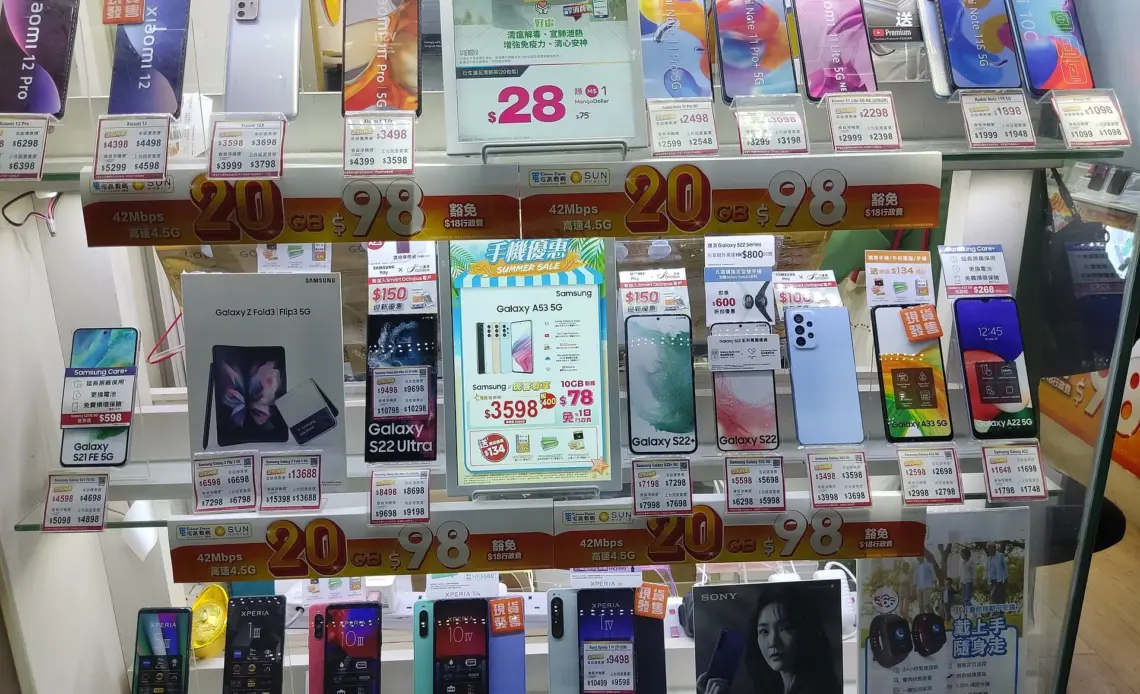
A $100 increase on a flagship phone looks like the memory shortage arriving in shops. It is closer to the opposite. Mobile DRAM and NAND contract prices have risen roughly fourfold since the fourth quarter of 2025, according to Counterpoint Research, while the headline price of a premium handset has moved by about 9%. Bloomberg’s Mark Gurman posted on 9 September 2026 that the iPhone 18 Pro and iPhone 18 Pro Max “will likely come in at only $100 higher than the phones they are replacing, so Apple is clearly eating a lot of the memory shortage cost increases here,” adding that “Google and Samsung also both raised prices by $100.” The gap between a 300%-plus input cost move and a 9% retail move does not disappear. It lands on gross margin. For finance professionals, handset pricing in 2026 is a balance-sheet event, not a consumer-price event.
Here is the part the market has been slow to price. The three largest premium handset makers are quietly funding a slice of the AI datacentre build-out out of their own gross margin, and they have told investors so in plain language. Apple chief financial officer Kevan Parekh told analysts on the 30 July earnings call that memory cost changes accounted for more than 100% of the sequential gross margin decline between the March and June quarters, with only partial offsets from carry-in inventory and cheaper non-memory components. Apple then guided September-quarter gross margin to 47%-48%, against a reported 50.1% in June. That is the transfer mechanism in one line: margin that would have accrued to Apple, Samsung and Google shareholders is now revenue at Micron, SK Hynix and Samsung’s semiconductor division, which is in turn steering wafer capacity into high-bandwidth memory for AI accelerators. The businesses that cannot run that trade – smaller Android OEMs, module houses and distributors in India, South East Asia and Africa – have no margin buffer at all. They pass it straight to the shelf. That is why Indian retail prices are up 21% and American prices are up 5%.
Key facts
- Memory prices have risen fourfold since Q4 2025, and global existing-model smartphone retail prices are up about 15% in 2026, with new launches 25% costlier year on year (Counterpoint Research, 3 September 2026).
- India +21% is the sharpest national retail price rise in the world, ahead of Asia Pacific +19%, Middle East and Africa +18%, Latin America +16%, China +10%, Europe +7% and North America +5% (Counterpoint Research).
- Apple guided September-quarter gross margin to 47%-48% versus 50.1% reported in the June quarter, with memory accounting for more than 100% of the sequential decline (Apple Q3 FY2026 earnings call, 30 July 2026).
- Conventional DRAM contract prices rose 90%-95% quarter on quarter in Q1 2026, the largest single-quarter move on record, and TrendForce still forecasts 13%-18% QoQ for DRAM and 10%-15% for NAND in Q3 2026 (TrendForce, 3 July 2026).
- Bank of America forecasts 2026 DRAM revenue up 51% and NAND up 45% year on year, on ASP increases of 33% and 26% respectively (Bank of America, via Kaohoon International).
- IDC expects global smartphone shipments to fall 12.9% to 1.12 billion units in 2026 while average selling prices rise 14% to a record $523 (IDC, 26 February 2026).
- Memory has climbed from roughly 15%-20% of the bill of materials on an entry-level handset to over 45% as of June 2026 (Counterpoint Research).
What is actually happening to memory costs
The mechanics are simple. Three meaningful DRAM suppliers exist globally, and all three have redirected leading-edge capacity toward high-bandwidth memory for AI accelerators, where margin per wafer is a multiple of what commodity LPDDR earns. Every HBM stack consumes far more wafer area than a conventional part of equivalent capacity, so the same fab output yields fewer sellable bits for phones.
Micron chief executive Sanjay Mehrotra has told investors the company can meet only around half to two-thirds of customer demand in the medium term, and that HBM’s die-trade ratio will exceed three-to-one at HBM4. Management also expects data centre DRAM and NAND to exceed 50% of industry total addressable market for the first time in calendar 2026. Consumer allocation is the residual, not the priority – a dynamic we examined when Micron’s DRAM share moved against SK Hynix pricing.
The pricing consequence has been violent. TrendForce recorded conventional DRAM contract prices rising 90%-95% quarter on quarter in the first quarter of 2026, with LPDDR5X average selling prices up 78%-83% QoQ in the second quarter and LPDDR4X up at least 70%-75%. NAND has followed. Even now, with the base effect enormous, TrendForce still models 13%-18% QoQ DRAM and 10%-15% QoQ NAND increases for the third quarter of 2026.
Stack those quarters and Counterpoint’s fourfold figure is arithmetic, not hyperbole. Xiaomi president Lu Weibing gave the clearest data point in April: a standard 12GB RAM plus 512GB storage set cost the company roughly 1,500 yuan more than in 2025, with some configurations near four times prior-year prices.
The equity market has understood the supply side perfectly well: Korean memory names have been repriced hard on AI demand signals, including the session when Samsung and SK Hynix rallied in Seoul on GPT-6 expectations. What has not been repriced with the same conviction is the other side of the ledger: the handset P&Ls absorbing the bill.
“What we are witnessing is not a temporary squeeze, but a tsunami-like shock originating in the memory supply chain,” said Francisco Jeronimo, Vice President for Worldwide Client Devices at IDC.
Who is absorbing and who is passing through
Absorption capacity is a direct function of gross margin. Apple runs a services-inflated corporate gross margin near 50% and can carry several hundred basis points of hardware cost inflation without breaching its guidance corridor. That is why a $100 increase on an iPhone 18 Pro – roughly 9% on the iPhone 17 Pro’s $1,099 – is a credible number even against a memory input line that has multiplied. Apple’s ability to hold the line is central to the bull and bear case around the stock under new leadership, and it is now the first real test for John Ternus, who took over as chief executive on 1 September.
Tim Cook was explicit about the trade-off on his final earnings call as chief executive. “We reluctantly raised prices,” he told analysts. “We’re in what I would characterize as a 100-year flood on memory pricing with exponential increases in memory prices.” Apple had already raised Mac and iPad prices in June rather than take the full hit on margin, and Cook confirmed the company expects to pay even higher memory costs in the September quarter.
Google has been unusually candid. The Pixel 11 line launched on 12 August at $899, $100 above the Pixel 10’s $799 entry point, and Google simultaneously removed the 128GB tier – a specification action that raises the effective floor price beyond the headline increase. Shakil Barkat, Vice President of Devices and Services at Google, said there has “never been an increase in memory prices like the world’s going through right now,” while flagging a dedicated engineering effort to reduce Android’s RAM footprint.
Samsung sits in the rare position of hedging itself. Its semiconductor division is a direct beneficiary of the same shortage that squeezes its mobile division, which is one reason the bull and bear range on the Seoul-listed shares is so wide. Even so, Samsung raised prices: the Galaxy Z Fold 8 Ultra launched at $2,099 at the 22 July Unpacked event in London, $100 above its equivalent predecessor, with the standard Z Fold 8 at $1,899. The Galaxy S26 entered at $899.99 for 256GB.
Now look at the players without a margin buffer. Chinese vendors including Huawei, Xiaomi and Honor have raised prices on selected flagship and mid-range models by between 200 yuan and 1,000 yuan, roughly $28 to $140. Transsion, the dominant vendor in Africa through Tecno, Infinix and itel, has taken the cleanest pass-through route: it guided first-half 2026 revenue up 22.6% to about RMB 35.66 billion and net profit up 44.8% to about RMB 1.76 billion on weaker unit shipments, meaning the entire result was carried by price. Memory cost per handset was reported to have risen around $16 year on year, about 37%.
The players that have stayed conspicuously quiet are the memory suppliers themselves. Micron, SK Hynix, Samsung Semiconductor and Kioxia have issued no public commentary on consumer affordability, and none has committed to ring-fencing capacity for low-end mobile. Their disclosures point the other way, toward multi-year supply agreements with datacentre buyers.
“Memory has become a key driver of smartphone BoM costs, resetting pricing across the industry and leaving OEMs with limited room to absorb higher costs,” said Tarun Pathak, Research Director at Counterpoint Research.
Market impact and data analysis
The dispersion between headline price rises and input cost rises is the whole story. The table below sets the four verified 2026 flagship price actions against the memory contract move over the same window.
| Vendor / model | 2026 price | Prior model | Change | Change % |
|---|---|---|---|---|
| Apple iPhone 18 Pro (reported) | $1,199 | $1,099 | +$100 | +9.1% |
| Google Pixel 11 | $899 | $799 | +$100 | +12.5% |
| Samsung Galaxy Z Fold 8 Ultra | $2,099 | $1,999 | +$100 | +5.0% |
| Samsung Galaxy S26 (256GB) | $899.99 | $799.99 | +$100 | +12.5% |
| Mobile DRAM and NAND contract, Q4 2025 to date | Approximately 4x | c. +300% | ||
Sources: Bloomberg reporting on iPhone 18 Pro pricing; Google Pixel 11 launch pricing; Samsung Unpacked, 22 July 2026; Counterpoint Research memory price index. Storage tiers are not like-for-like in every row.
The regional dispersion tells you exactly where absorption ends and pass-through begins.
Three observations follow. First, price elasticity is doing the rationing. IDC’s forecast of a 12.9% shipment decline alongside a 14% ASP rise to a record $523 describes a market where volume is being sacrificed to protect unit economics. That is a revenue-neutral-at-best outcome for the industry and a clearly negative one for component suppliers outside memory.
Second, the low end is being deleted rather than repriced. Counterpoint’s tiering shows bill-of-materials cost increases of 20%-30% for sub-$200 devices against 10%-15% for mid and high-end. European average selling prices have hit records partly because the cheap tier has stopped being manufactured.
Third, the margin transfer is quantifiable in aggregate. Bank of America’s 2026 forecast of DRAM revenue up 51% and NAND up 45%, on ASPs up 33% and 26%, describes tens of billions of dollars of incremental memory revenue. In 2026 that money is coming from device-maker gross margin and from consumers in price-sensitive markets, in roughly that order.
“The low end of the market is impacted most severely, with BoM costs increasing by 20%-30% since the year’s start,” said MS Hwang, Research Director at Counterpoint Research.
The regional and regulatory picture
India is the clearest stress test anywhere in the world. Roughly half the Indian market sits below Rs 20,000, a band with almost no gross margin to give. Memory has moved from 15%-20% of the bill of materials on entry-level devices to over 45% as of June 2026, and reported per-device price increases have ranged from about Rs 500 to Rs 8,000, averaging around Rs 1,500. The 21% national average price rise is not a pricing strategy. It is arithmetic imposed on distributors and retailers with no alternative.
The policy response so far is tax relief rather than price control. The India Cellular and Electronics Association has renewed its call for a GST cut to 12% on handsets, and the All India Mobile Retailers Association has formally asked the Finance Ministry to cut GST from 18% to 5% on devices priced below Rs 15,000. India’s September GST rationalisation to a two-slab structure left smartphone rates unchanged, so the ask remains live.
Europe presents a different shape. The 7% average price rise is mild by global standards, but the number flatters the picture: it is measured on a shrinking, upward-skewed model mix in which the affordable tier is disappearing rather than inflating. No European competition investigation into memory pricing has been publicly confirmed at the time of writing, and no formal price-gouging inquiry into DRAM or NAND suppliers has been announced. Given the three-supplier structure of the DRAM market, which Apple’s own management acknowledged on the July call when discussing supply diversification, that absence is itself worth monitoring.
Africa and the Middle East, at 18%, are absorbing the shock through Transsion’s pass-through model and a visible shift toward lower storage configurations. The pattern holds everywhere: where distributors are thin-margin intermediaries rather than vertically integrated brands, the cost reaches the consumer within a quarter.
“Prices for new smartphones are expected to keep rising over the coming quarters, including for the upcoming iPhone 18 series,” said Karn Chauhan, Senior Analyst at Counterpoint Research.
What happens next
First, expect a second wave of premium price increases in the first half of 2027 rather than a reversal. The absorption strategy works while carry-in inventory purchased at old contract prices is still flowing through cost of goods sold. Apple explicitly flagged that this benefit is diminishing. Once the inventory cushion is exhausted and 2027 contracts reset at current levels, the arithmetic that supports a $100 increase this year supports a larger one next year. Watch the September-quarter gross margin print against the 47%-48% guide as the first hard confirmation.
Second, expect specification downgrades to do more work than price. Counterpoint analysts have already documented reduced camera, display, audio and memory configurations, plus portfolio pruning and the migration of buyers toward Pro variants. Google’s removal of the 128GB Pixel tier is the template: raise the effective floor without printing a bigger headline number. That is a price rise which never reaches a price index.
Third, expect supply relief no earlier than 2027, and expect it to be partial. Lu Weibing has said new memory output is unlikely to arrive before 2027, and HBM capacity across SK Hynix, Samsung and Micron is reported sold out through 2026. Incremental capacity will be qualified for the highest-margin AI products first. The base case is a plateau at elevated levels in the second half of 2027, not mean reversion to 2025 costs.
For brokers, exchange operators and institutional allocators, the tradeable observation is that the memory shortage has produced two distinct exposures that are usually modelled as one. The supplier side is a straightforward margin expansion story with visible pricing power. The device side is a margin compression story with a lag, concentrated in companies whose consensus estimates were built before contract prices multiplied. The dispersion between those two, not the direction of memory prices, is where the mispricing sits.
Frequently asked questions
Why is a $100 phone price rise evidence of absorption rather than pass-through?
Because the input cost rise is far larger. Counterpoint Research puts the memory price increase at roughly fourfold since Q4 2025, and memory now exceeds 45% of the bill of materials on entry-level devices. A $100 increase on a $1,099 phone is about 9%. The shortfall between those two numbers is carried on the manufacturer’s gross margin, which Apple’s own guidance confirms.
How much has Apple’s gross margin actually moved?
Apple reported 50.1% gross margin in the June 2026 quarter and guided September to 47%-48%, including roughly one percentage point of tariff refund benefit. Chief financial officer Kevan Parekh told analysts that memory cost changes accounted for more than 100% of the sequential decline from March to June, with partial offsets from inventory and cheaper non-memory components.
Why has India seen the world’s sharpest handset price rise?
Roughly half the Indian market sits below Rs 20,000, where gross margins are too thin to absorb component inflation. Memory has moved from 15%-20% to over 45% of the bill of materials on entry-level phones. Counterpoint Research recorded a 21% average retail price rise in India during 2026, ahead of Asia Pacific at 19% and Middle East and Africa at 18%.
Which companies benefit financially from this shortage?
Memory suppliers. Bank of America forecasts 2026 DRAM revenue up 51% and NAND up 45%, on ASPs up 33% and 26% respectively. Micron, SK Hynix, Samsung’s semiconductor division and Kioxia are the direct beneficiaries. None has publicly committed to protecting low-end mobile allocation, and their capacity is weighted toward high-bandwidth memory for AI datacentres.
When will memory prices normalise?
Not before 2027 on current evidence. Xiaomi president Lu Weibing has said new memory output is unlikely to arrive before 2027, and HBM capacity across the three major suppliers is reported sold out through 2026. TrendForce still forecast 13%-18% quarter-on-quarter DRAM increases for Q3 2026. A plateau at elevated levels is more plausible than a return to 2025 pricing.
What should analysts watch next?
Three markers. Apple’s September-quarter gross margin against the 47%-48% guide. The 2027 contract reset, which removes the carry-in inventory cushion that has masked the full cost. And specification downgrades such as Google’s removal of the 128GB Pixel tier, which raise effective prices without appearing in published price indices.