
The story you will read about Bloom Energy this month is that S&P 500 inclusion validates the stock. It does not. Index membership is a flow event, not a fundamental one — and the uncomfortable fact for anyone using 21 September as a reason to buy is that Bloom’s 361% twelve-month gain, from $54.91 on 4 September 2025 to $252.87 on 4 September 2026, was delivered entirely without a single passive index buyer. The shares rose 7.35% on 4 September and added a further 5.25% in after-hours trade to $266.14 on the inclusion news. What changes on 21 September is who owns the stock, not what it is worth.
What it is worth is a genuinely hard question, and here is the framing that gets closest to it. Bloom is no longer best understood as a project developer or a utility. After Brookfield raised its financing framework fivefold to $25 billion on 30 June 2026, Bloom became an equipment vendor with a captive balance sheet behind it — it sells the fuel-cell box, Brookfield owns the deployed asset, the data-centre operator buys the power. That is structurally the same arrangement the residential solar industry ran in the 2010s, and its lesson is uncomfortable: in that model, the financing partner’s cost of capital, not the vendor’s technology, sets the growth ceiling. Our $400 bull case assumes that ceiling stays high through 2027. Our $145 bear case is what the stock is worth if the multiple, rather than the order book, does the adjusting.
Key facts: Bloom Energy (BE) at a glance
- Share price: $252.87 at the 4 September 2026 close, +7.35% on the day; 52-week range $52.00–$351.28 — stockanalysis.com
- Performance: +191.0% year to date and +360.6% over twelve months, but 26.9% below the record close of $345.85 set on 22 June 2026
- Q2 2026 revenue: $1.065 billion, up 165.5% year on year — the first billion-dollar quarter in company history (results, 28 July 2026)
- Q2 2026 margins and earnings: GAAP gross margin 33.4%, non-GAAP 34.3%; GAAP diluted EPS $0.62, non-GAAP $0.78
- FY2026 guidance (raised): revenue $3.9–4.2 billion and non-GAAP EPS $2.55–2.85 — roughly 100% revenue growth at the midpoint
- Brookfield framework: increased from $5 billion to $25 billion on 30 June 2026, inside Brookfield’s targeted $100 billion AI infrastructure fund
- Oracle agreement: master services agreement of 13 April 2026 for up to 2.8 GW, with an initial 1.2 GW contracted and a warrant over 3.53 million Bloom shares
- Index event: joins the S&P 500 before the open on 21 September 2026 (announced 4 September 2026)
- Institutional positioning: 116 hedge funds held the stock at the end of Q2 2026 with $10.8 billion of value, up from 91 funds and $4.5 billion a quarter earlier
What Bloom actually sells, and why it is winning now
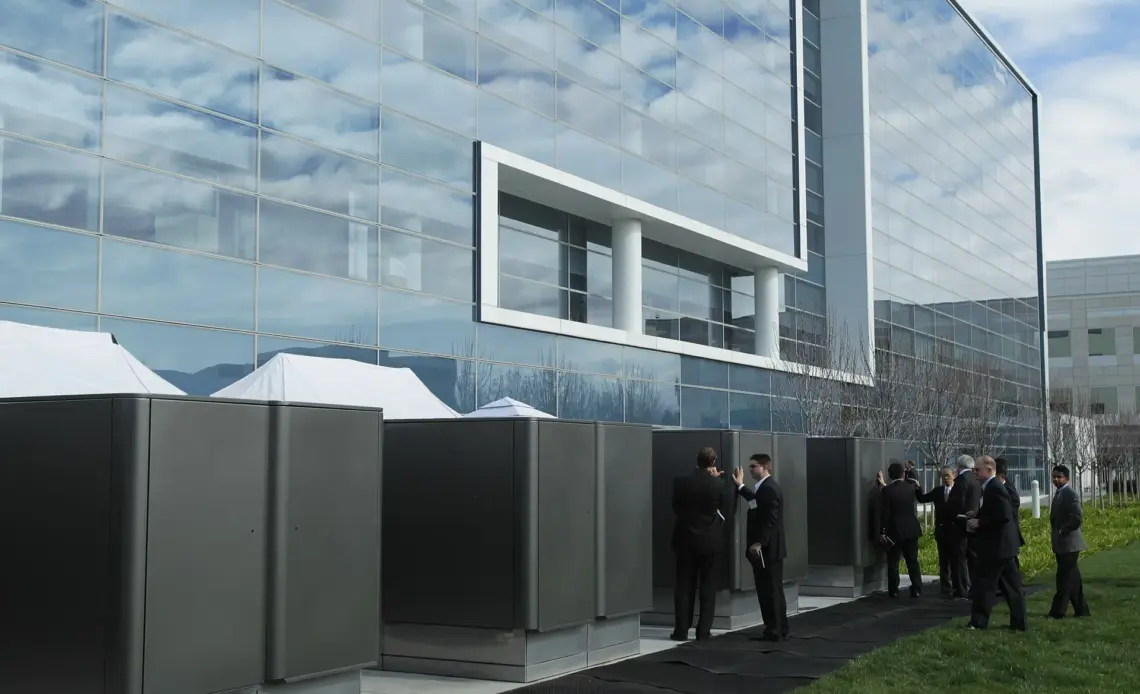
Bloom’s product is a solid-oxide fuel cell — an electrochemical box that converts natural gas, biogas or hydrogen into electricity on site, without combustion and without a transmission line. The engineering has existed for years. What changed is the queue. A hyperscaler that wants 100 MW from the grid in a constrained interconnection region is quoted a wait measured in years; Bloom says it can deploy in 90 days or less. In an industry where the cost of not having power is a delayed GPU cluster, speed is worth more than efficiency.
That advantage converted into financial results with unusual violence in 2026. Q2 revenue of $1.065 billion was up 165.5% year on year and crossed a billion dollars for the first time. GAAP gross margin reached 33.4% — the number that matters most, because it demonstrates the company is not buying growth with price. Management raised full-year guidance to $3.9–4.2 billion of revenue with non-GAAP EPS of $2.55–2.85, implying roughly 100% growth at the midpoint.
The company has also been attacking its own installation bottleneck. On 19 August 2026 it introduced Power Connect, a domestically manufactured and assembled deployment system that it says cuts installation time by more than 40%. Two weeks earlier, on 6 August, it expanded a microgrid deployment at MiTAC’s Fremont, California facility; the AI infrastructure segment now spans roughly 250 MW across nearly two dozen customers. The largest single commitment sits outside those numbers. On 13 April 2026 Bloom and Oracle expanded a master services agreement under which Oracle intends to procure up to 2.8 GW of Bloom systems, of which an initial 1.2 GW is already contracted and deploying. Oracle also took a warrant over 3.53 million Bloom shares, which aligns the customer with the equity rather than merely with the delivery schedule — an unusual and telling structure.
How the rest of the power complex has responded
The most consequential response came from Brookfield Asset Management, which on 30 June 2026 raised its Bloom financing framework fivefold, from $5 billion to $25 billion, positioning it inside a targeted $100 billion AI infrastructure fund. Read that as a credit judgement rather than an endorsement of the technology: Brookfield is agreeing to own long-lived assets whose cash flows depend on data-centre tenants honouring power contracts. It is the same underwriting question that private capital is now asking across the sector.
Compare the alternatives an AI operator actually faces today, because that comparison is where Bloom’s premium comes from. Building private gas generation from scratch is the Fermi route — years of permits, turbines and construction risk before a single megawatt is delivered, as set out in our Fermi (FRMI) bull and bear analysis. Buying merchant power from an incumbent generator is the Vistra route, which works but is hedged years forward and cannot be scaled on demand. Waiting for small modular reactors is the NuScale route, which is a 2030s answer to a 2026 problem. Bloom’s competitive position is not that its fuel cell is the cheapest electron; it is that it is the fastest electron.
The hedge fund community responded to the same logic with capital. Holdings rose from 91 funds owning $4.5 billion at the end of Q1 2026 to 116 funds owning $10.8 billion at the end of Q2. That is a crowded book by any measure, and it is the mechanical reason the stock fell 26.9% from its 22 June peak into late August despite guidance being raised in between. Positioning, not fundamentals, drove that drawdown — the same dynamic that has repeatedly whipsawed the wider energy complex covered in our energy-stock round-up.
Market impact and the arithmetic behind $400 and $145
Start with the multiple, because it is the entire argument. At $252.87 against the midpoint of management’s own FY2026 non-GAAP EPS guidance of $2.70, Bloom trades on roughly 94 times this year’s earnings. That is not a number you can defend with a discounted cash flow. It is a number you defend with a growth rate — and the growth rate is real: 165.5% revenue growth in Q2, guidance implying about 100% for the full year.
The bull case at $400. Assume the Brookfield framework is drawn on at scale and the Oracle agreement moves from 1.2 GW contracted towards its full 2.8 GW through 2027. Revenue of roughly $7 billion in FY2027 — around 75% growth on the FY2026 midpoint, a deceleration from 2026’s pace — at gross margins holding in the mid-30s and with operating leverage on a largely fixed engineering base would support non-GAAP EPS near $5.00. Eighty times that is $400. Note what the bull case does not require: no margin expansion, no new customer category, and a growth rate materially slower than the one just delivered. It requires only that the deceleration be gentle and that the multiple compress from 94x to 80x while earnings double.
The bear case at $145. Nothing here needs the demand story to break. Hold FY2026 EPS at the $2.70 midpoint and re-rate the stock to 54 times — still a growth multiple, still far above the S&P 500 — and you get $145. That is also, not coincidentally, the level the stock traded around between January and March 2026 before the spring re-rating, so it is a price this shareholder base has already lived with. The trigger would most likely be an order-timing disappointment rather than a demand shock: capital-equipment vendors selling into a build cycle habitually pull revenue forward, and a single quarter of shipment slippage in a 94x stock is worth 40% of the price.
| Bull case ($400) | Bear case ($145) |
|---|---|
| FY2027 revenue near $7bn (~75% growth) with mid-30s gross margin | Growth decelerates to 40–50% and the multiple compresses to ~54x FY26 EPS |
| Brookfield’s $25bn framework is drawn on at scale, removing the funding constraint | Financing partner’s cost of capital rises, slowing deployments Bloom cannot fund alone |
| The remaining 1.6 GW of the Oracle agreement converts from intent into contract | Order timing slips a quarter — routine for capital equipment, brutal at 94x earnings |
| Passive inflows from 21 September S&P 500 entry structurally lower the float | The crowded hedge fund book (116 holders, $10.8bn) unwinds as it did after 22 June |
One synthesis worth carrying away: Bloom’s June-to-August drawdown of 26.9% happened while the company raised guidance and Brookfield quintupled its framework. Fundamentals and price moved in opposite directions for ten weeks. That is the signature of a stock whose marginal buyer is a positioning decision, not a valuation decision — which is precisely what index inclusion changes on 21 September, when a mechanical, price-insensitive buyer enters the register for the first time.
The regulatory and fuel question nobody wants to answer
Bloom’s fuel cells run predominantly on natural gas. They do so more cleanly than combustion — no NOx, no particulates, higher electrical efficiency — but they are not zero-carbon, and the marketing distance between “clean energy” and “lower-emission gas” is where the regulatory risk lives. In California, where much of the installed base sits, air districts and the state’s climate accounting have repeatedly revisited how behind-the-meter gas generation is treated. A change in that treatment would not stop deployments; it would change their economics.
The federal picture cuts the other way. Data-centre power demand has become an explicit policy priority, and behind-the-meter generation is the only lever that adds capacity on a two-quarter timeline rather than a five-year one. Grid operators facing multi-year interconnection queues have a structural incentive to permit private generation, because every megawatt served on site is a megawatt that does not need transmission built for it.
The tension to watch through 2027 is gas price and gas access rather than carbon rules. Fuel cost is a pass-through in most contracts, but pass-throughs only hold while the customer’s alternative is worse. If US gas prices rise materially — a live risk given LNG export growth and the same data-centre demand Bloom is selling into — the cost gap between an on-site fuel cell and a delayed grid connection narrows. That is the quiet variable in every 2027 model, including ours, and it is one reason we watch the crude and gas complex closely in our oil price prediction.
What happens next: three predictions
1. The index-inclusion premium partially reverses after 21 September. The 7.35% move on 4 September plus 5.25% after hours is anticipatory flow. Once the passive buying is done, the marginal buyer disappears and the stock re-couples to earnings news. Expect the inclusion trade to be a source of supply, not demand, in the final week of September.
2. Q3 2026 results are the first real test of the Brookfield structure. The framework was raised on 30 June, so Q3 is the first full quarter under it. What matters is not revenue — that is guided — but how much deployment is being financed on Brookfield’s balance sheet versus Bloom’s. The higher that ratio, the more the company looks like a vendor and the less like a developer, and vendor multiples are more durable than developer multiples.
3. The 2027 guide, not the 2026 result, sets the stock. With FY2026 essentially locked at $3.9–4.2 billion, the number that decides whether $400 or $145 is right is the first FY2027 revenue frame management gives. A guide starting with a 7 keeps the bull case alive. Anything starting with a 5 makes 94 times earnings indefensible, and the re-rating to the mid-$100s follows quickly.
Having covered the AI power trade across generation, fuel cells and networking through 2026, our read is that Bloom is the highest-quality business in the group and the most dangerous share price. Both statements are true at once, and the gap between them is why we frame this as $400 versus $145 rather than a single target.
Frequently asked questions
What is the Bloom Energy stock prediction for 2027?
Our framework sets a $400 bull case and a $145 bear case against the $252.87 close of 4 September 2026. The bull case requires FY2027 revenue near $7 billion with mid-30s gross margins, supporting non-GAAP EPS around $5.00 at an 80x multiple. The bear case requires no demand shock at all — only a re-rating to roughly 54 times the midpoint of the company’s own FY2026 non-GAAP EPS guidance.
When does Bloom Energy join the S&P 500?
Bloom Energy joins the S&P 500 before the market open on 21 September 2026. The announcement on 4 September lifted the shares 7.35% in the session and a further 5.25% in after-hours trade to $266.14. Index inclusion changes the ownership base rather than the fundamentals, and the anticipatory flow it generates typically fades after the effective date.
How fast can Bloom Energy deploy power compared with the grid?
Bloom says its systems can be deployed in 90 days or less, against interconnection queues measured in years in constrained regions. Its Power Connect system, launched on 19 August 2026, is claimed to cut installation time by more than 40% again. Speed to power, rather than cost per megawatt-hour, is the core of the commercial pitch to AI data-centre operators.
Is Bloom Energy profitable?
Yes, on both measures in the most recent quarter. Q2 2026 delivered GAAP diluted EPS of $0.62 and non-GAAP diluted EPS of $0.78 on revenue of $1.065 billion, with GAAP gross margin of 33.4%. Full-year 2026 guidance calls for non-GAAP EPS of $2.55–2.85, which places the stock at roughly 94 times the midpoint at the current price.
What is the Brookfield agreement worth to Bloom Energy?
Brookfield raised its financing framework with Bloom fivefold on 30 June 2026, from $5 billion to $25 billion, as part of a targeted $100 billion AI infrastructure fund. It is a financing capacity rather than an order, but it removes the balance-sheet constraint that would otherwise cap how fast Bloom can deploy — which is why the partner’s cost of capital now matters as much as Bloom’s own technology roadmap.
Why did Bloom Energy stock fall 27% from its June high?
Between the record close of $345.85 on 22 June 2026 and late August, the shares fell 26.9% even though the company raised guidance and Brookfield quintupled its framework in the same window. The move was positioning rather than fundamentals: hedge fund ownership had doubled in value to $10.8 billion by the end of Q2, and a crowded book unwinds on any pause in momentum.
This article is analysis, not investment advice. Prices and scenario levels are as of the 4 September 2026 close.