Archer reported second-quarter (Q2) results after the close, and the earnings were the least interesting part. The company booked $5 million in revenue last quarter. On the same afternoon, it announced a deal to acquire three Boeing-owned businesses, one of which alone generates more than $200 million in annual revenue. That gap, between what Archer earns today and what it just agreed to buy, is the entire story, and it is why the market looked past a widening loss and sent the stock up about 12%.
The transaction reframes what Archer is. Until now it has been an electric air-taxi company burning cash toward a certification it has not yet achieved. With this deal, it becomes an aerospace-and-defense operator with real revenue, a fleet of military drones, and Boeing as a strategic shareholder. Archer is calling the combined entity a “physical AI” platform, and for once the AI framing is doing real work rather than decorating a press release.
Archer Aviation (ACHR) jumped about 12% after announcing the Boeing acquisition alongside its Q2 results, extending a roughly 18% gain over the week to near $5.60. Source: TradingViewThe Archer-Boeing Transaction
Archer has signed definitive agreements to acquire Boeing’s Wisk Aero, Insitu and SkyGrid subsidiaries, paying not with the $1.56 billion in cash on its balance sheet but with equity. In exchange, Boeing takes a stake in Archer and becomes a strategic partner, and the two enter a technology-sharing arrangement under which Boeing retains access to Wisk’s autonomous-flight technology for its own commercial and defense aircraft.
The structure is telling. Archer is cash-rich by startup standards, yet it chose to preserve that runway and hand Boeing equity instead, bringing the aerospace giant onto its shareholder register rather than depleting its treasury. Boeing, for its part, offloads three non-core businesses it had funded for two decades while keeping upside through its Archer stake.
“This transaction is a win-win for Boeing and Archer,” said Brian Yutko, a Boeing vice president, framing it as a way for Boeing to capitalize on those long-running investments while refocusing on its core aircraft programs. The deal is subject to antitrust clearance under Hart-Scott-Rodino and is expected to close by the end of the year.
The Q2 Numbers and Why the Loss Widened
The quarterly results themselves were secondary, and reading them correctly means separating two different things. Revenue of $5 million beat the roughly $1.96 million analysts expected, a clean top-line beat. The GAAP net loss widened to $263.2 million, up from $206 million a year earlier and $217.7 million the prior quarter, but on a per-share basis the loss of $0.34 was actually slightly better than the $0.36 loss in the same quarter last year, since Archer’s share count has grown. The dollar figure got bigger; the per-share loss did not.
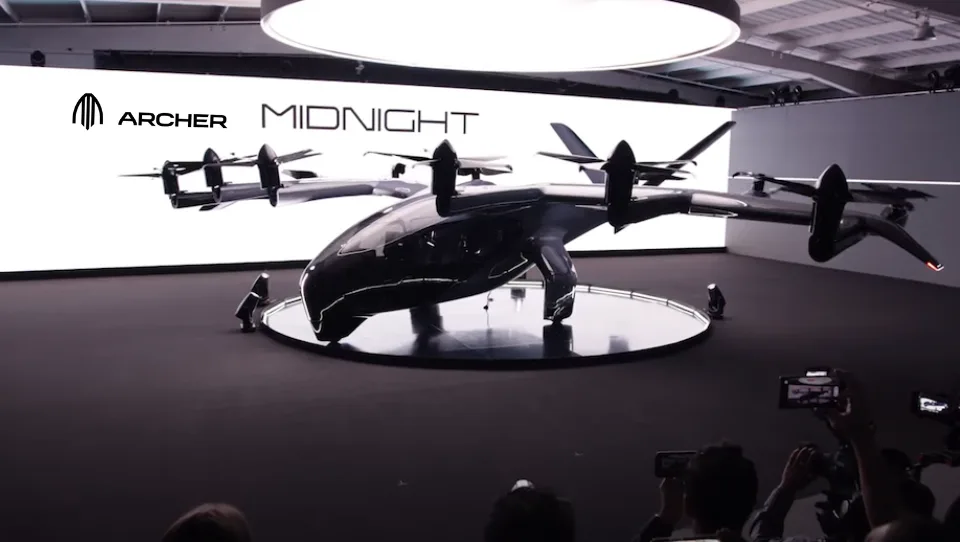
Archer’s Q2 2026 loss of $0.34 a share missed the $0.25 estimate, but the miss was driven by a $6 million one-time litigation settlement and non-cash warrant swings, not operational deterioration. Source: Archer SEC filingWhat widened the loss was deliberate spending, not deterioration. Archer’s second-quarter release shows research and development expense rising to $186 million from $122.4 million a year earlier, as the company invested in flight testing, FAA certification and production for its Midnight aircraft, plus development of its hybrid aircraft and ZEE, its aerospace AI foundation model. The clearest evidence that the burn was on plan rather than running away is that adjusted EBITDA came in at a loss of $177.1 million, at the lower end of the company’s own guidance range of $170 million to $200 million.
The per-share figure carried some one-time and non-cash noise on top of that operational spend. The quarter included a $6 million accrued one-time litigation settlement expense and $0.4 million in acquisition-related costs, both of which Archer adds back to reach its adjusted numbers, along with a roughly $19 million sequential swing from lower non-cash gains on warrant fair value. None of those reflect the underlying business getting worse. Archer ended the period with $1.56 billion in cash, cash equivalents and short-term investments, the war chest that let it pursue an all-equity acquisition rather than spend down its balance sheet.
CEO Adam Goldstein framed the quarter around the transformation rather than the loss, calling it “an important inflection point for Archer” as the company advances what he described as a diversified, multi-platform strategy “across air taxis, UAS and AI.”
What Wisk, Insitu and SkyGrid Actually Do
The three businesses turn Archer from a single-product hopeful into a multi-line operator. Insitu is the prize: a profitable defense business that has manufactured and fielded more than 3,500 unmanned aircraft systems, with operations across 35 countries. It brings the $200 million-plus in annual revenue and, crucially, a foothold in military drones at a moment when defense-tech demand is surging. Wisk Aero is an autonomous eVTOL developer, complementary to Archer’s own air taxi but built around pilotless flight. SkyGrid builds AI-driven, aircraft-agnostic air-traffic-management software, the digital layer needed to coordinate automated airspace at scale.
Archer’s pitch is that these three, combined with its own aerospace AI foundation model, which it calls ZEE, form an end-to-end “physical AI” platform spanning aircraft, autonomy software and airspace management. Whether that integration delivers is unproven, but the components are real businesses with real deployments, which is a different proposition from a pre-revenue promise.
Investor Takeaway
The revenue-scale change is the point: Insitu’s $200 million-plus in annual sales dwarfs Archer’s $5 million quarter, converting a pre-revenue story into an operating one overnight.
What Remains Unproven
The transformation is a plan, not yet a result, and the caveats are substantial. The deal must clear antitrust review and close, which is not guaranteed until it happens, and integrating three businesses with distinct cultures and technologies is the kind of task that has undone larger companies. Archer’s original mission also remains unfinished: FAA certification of its air taxi, and the US and UAE pilot programs plus the Texas flight testing it has targeted for this year, still have to be delivered, and the Boeing deal does not change that clock.
There is also the question of what Archer becomes. A company that was a bet on urban air mobility is now, pending close, a defense-and-autonomy operator whose largest revenue source is military drones. That is a coherent story in a market hungry for defense-tech and AI exposure, and it connects Archer to the broader run in space and frontier-aerospace stocks that rallied through early August. But it is a different company than the one many investors originally bought. For how the range of outcomes maps to the stock, FinanceFeeds’ Archer forecast frames a bull case at $18 against a bear case at $4.28, a spread this deal only widens.
The market’s initial verdict was clear enough: up about 12% on the day and 18% over the week, with investors rewarding the leap from a $5 million quarter toward a $200 million revenue base. Whether that optimism holds depends on a close, an integration, and a certification, none of which is finished. Archer’s own results came alongside Rocket Lab and AST SpaceMobile the same night, which framed certification as its scorecard. It just added three more scorecards to watch.
Investor Takeaway
The deal’s value depends entirely on execution: antitrust clearance, a clean close, and integrating three businesses, none of which is certain, and any of which could stall the re-rating.