
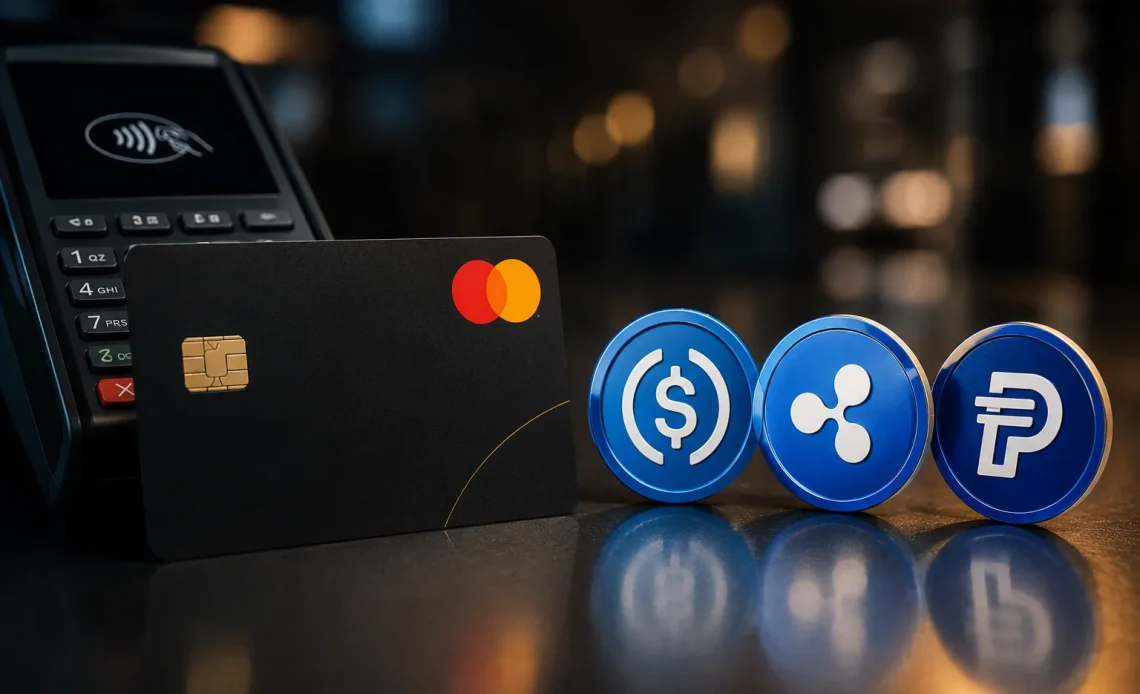
Mastercard has significantly expanded its stablecoin strategy by completing the acquisition of BVNK, a leading stablecoin payments infrastructure provider, while simultaneously joining Visa as a founding participant in the Open USD stablecoin initiative.
The combination places Mastercard at the center of two of the industry’s most important developments: ownership of a stablecoin payments platform that has processed more than $30 billion in annualized transaction volume, and participation in a consortium developing what could become one of the world’s largest open, business-focused stablecoins.
Mastercard announced the completion of its acquisition of BVNK on August 3, describing the transaction as a major step toward expanding blockchain-based payment capabilities. Financial terms were not disclosed in the completion announcement, although Mastercard had previously agreed to acquire BVNK for up to $1.8 billion, including contingent payments tied to performance milestones.
BVNK provides infrastructure that allows banks, fintechs and enterprises to move seamlessly between traditional fiat currencies and blockchain-based stablecoins. Its platform supports payments across more than 130 countries and multiple public blockchain networks, positioning Mastercard to integrate stablecoin settlement directly into its existing payments ecosystem.
Open USD Unites Former Rivals
The acquisition comes just weeks after Mastercard and rival Visa joined more than 140 financial institutions and technology companies in launching Open Standard, the consortium behind the upcoming Open USD stablecoin.
Unlike existing stablecoins issued by a single company, Open USD is designed as an industry-owned digital dollar that allows businesses to mint and redeem tokens without volume restrictions. After management fees, reserve earnings will be shared among consortium participants, aligning incentives across banks, payment companies and fintech providers.
The participation of both Mastercard and Visa is particularly significant given the companies’ decades-long rivalry in traditional card payments.
Rather than competing over proprietary stablecoins, both firms are helping develop common infrastructure intended to accelerate enterprise adoption of blockchain-based payments.
The initiative follows the passage of the GENIUS Act, which established the first comprehensive federal framework governing payment stablecoins in the United States and has encouraged major financial institutions to accelerate their digital asset strategies.
Payments Industry Prepares for Stablecoin Growth
Mastercard’s acquisition of BVNK reflects a broader shift across the payments industry as traditional networks seek to remain relevant in a future where value increasingly moves over blockchain rails.
Historically, Mastercard’s role ended after authorizing and routing card transactions between banks. Stablecoins introduce a new settlement layer where money itself can move on public blockchain networks in seconds, potentially reducing costs for cross-border transfers, treasury operations and business payments.
By combining BVNK’s infrastructure with Mastercard’s global merchant and banking relationships, the company aims to provide institutional clients with integrated fiat-to-stablecoin payment services without requiring them to build blockchain capabilities internally.
The strategy also mirrors moves by Visa, Stripe and several global banks that have expanded investments in tokenized payments over the past year.
Supporters argue that stablecoins could modernize international payments by enabling faster, cheaper and programmable settlement. Critics caution that mainstream adoption will depend on regulatory clarity, interoperability and widespread merchant acceptance.
For Mastercard, however, the direction is becoming increasingly clear. Ownership of a stablecoin infrastructure platform processing roughly $30 billion annually, combined with a leadership role in the Open USD ecosystem alongside Visa, signals that one of the world’s largest payment networks is positioning blockchain-based settlement as a core component of its future payments strategy rather than a niche cryptocurrency experiment.