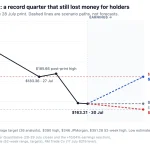

Bitcoin remained volatile on Tuesday as traders weighed renewed ETF demand against macroeconomic uncertainty, corporate treasury selling and fragile technical conditions after a difficult first half of 2026.
The largest cryptocurrency traded near $63,200, with an intraday range between roughly $61,350 and $64,435. The move reflected continued instability after Bitcoin briefly reclaimed the $63,000 level but failed to establish a decisive breakout. The price action followed several weeks of sharp swings that have left investors debating whether the market is stabilizing or merely rebounding within a broader correction.
Bitcoin has struggled through much of 2026. Reuters reported in June that the asset had lost roughly one-third of its value for the year at that point, marking its weakest performance for that stage of a year since at least 2015. The decline coincided with a rotation of investor attention toward artificial intelligence stocks, large technology listings and yield-bearing assets, reducing Bitcoin’s appeal as a high-beta store-of-value trade.
ETF Flows Offer Relief, Not Certainty
The latest improvement in sentiment came from U.S. spot Bitcoin ETF flows. Farside Investors data showed that the funds recorded $223.5 million of net inflows on July 2, ending a stretch of heavy redemptions. Fidelity’s FBTC led the session with $166.0 million of inflows, while Ark and 21Shares’ ARKB added $91.8 million. BlackRock’s IBIT, however, posted $40.4 million of outflows, showing that demand was not evenly distributed across issuers.
That rebound helped Bitcoin recover from a difficult period in which ETF redemptions amplified downside pressure. Earlier reports showed that U.S. spot Bitcoin ETFs had suffered one of their heaviest outflow periods since launch, with billions of dollars leaving the products during a multi-week drawdown. Because ETFs have become one of the most important channels for institutional Bitcoin exposure, daily flow data now plays a larger role in short-term price direction.
Still, the ETF rebound does not remove volatility risk. A single positive session can stabilize sentiment, but sustained inflows are needed to offset selling from miners, leveraged traders and corporate holders. Bitcoin’s liquidity profile also remains vulnerable around U.S. trading hours, when ETF flows, macro data and derivatives positioning interact most directly.
Strategy Sales Add Supply Concern
Corporate treasury behavior has also become a source of market sensitivity. Strategy, formerly MicroStrategy, reportedly sold 3,588 BTC between June 29 and July 5 after years of positioning itself as a long-term corporate holder. The company also reported an $8.32 billion loss on its digital asset holdings for the second quarter of 2026, reflecting the steep decline in Bitcoin from prior cycle highs.
The sales matter because Strategy has long been viewed as a symbolic anchor for institutional Bitcoin conviction. Any shift from accumulation to selective monetization can affect market psychology, especially if investors begin to question whether other leveraged or balance-sheet-driven holders may also sell during periods of stress.
Macro conditions remain another driver. Bitcoin has traded less like a defensive asset and more like a high-duration risk asset, reacting to interest-rate expectations, dollar strength and changes in technology-sector momentum. Geopolitical uncertainty and elevated borrowing costs have also limited the argument that Bitcoin is functioning as a reliable near-term safe haven.
For investors, the current setup is mixed. ETF inflows suggest that institutional demand has not disappeared, but wide intraday ranges show that confidence remains fragile. Bitcoin’s next move will likely depend on whether inflows persist, corporate selling slows and the asset can hold above the $60,000 support area. Until then, volatility remains the dominant market signal.