
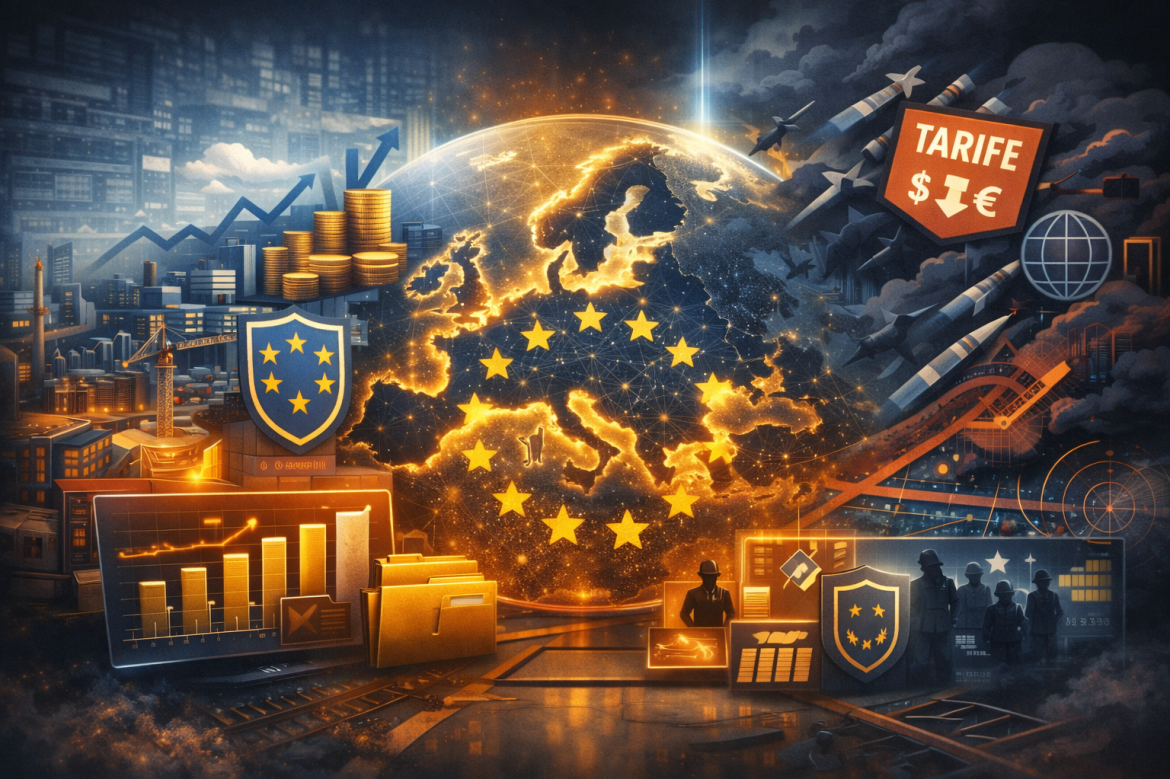
Europe bulletin: UK confidence wobbles, Germany’s nuclear idea, EU’s strong growth
Europe enters the year in a state of strategic tension: resilient at home, uneasy abroad.
Businesses are still hiring and investing, but confidence is wobbling as global risks mount. From boardrooms rattled by trade threats to governments quietly redesigning defense and deterrence, the continent is adapting in real time.
Growth has surprised on the upside, yet security, trade, and geopolitics are reshaping priorities faster than economic models can keep up.
UK business confidence weakens amid global economic doubts
UK business confidence stumbled in January as executives turned increasingly pessimistic about the global economy.
Lloyds’ Business Barometer fell to +44% from +47% in December, driven by a sharp 14-point collapse in economic optimism to +28%, its lowest in a year.
The timing wasn’t coincidental: Trump’s tariff threats against Britain and European nations dominated the survey window (January 5-20), rattling boardrooms already unmoored by post-budget uncertainty.
The silver lining? Firms remain confident in their own operations, with trading prospects climbing to a three-month high of +59%.
Hiring intentions and wage expectations strengthened, too, signaling resilience at the ground level.
The contradiction reveals a UK economy caught between two realities: businesses adapting and investing locally while watching darkening skies globally.
Germany eyes European nuclear deterrent amid Trump uncertainty
Chancellor Friedrich Merz confirmed Thursday that Europe is beginning early-stage talks on a shared nuclear umbrella, not to replace the US arrangement, but to supplement it.
The move signals profound anxiety about Washington’s reliability under Trump, who’s rattled allies with Greenland acquisition rhetoric and tariff threats.
Germany itself remains legally barred from owning nukes under the 1990 and 1969 treaties, but Merz pivoted smartly: Germany can’t build warheads, but it can architect a European system with France and Britain’s arsenals.
The pivot matters because six of ten Germans now distrust the US nuclear deterrent, a seismic shift for a nation that built its post-WWII identity around Atlantic security.
Merz emphasized timing isn’t now, framing talks as long-term reflection rather than panic. But the subtext screams urgency: European strategic autonomy isn’t optional anymore, it’s existential.
Europe raids crisis fund vault for defense
Europe’s crisis kitty just got a second act.
Pierre Gramegna, head of the European Stability Mechanism, revealed Thursday that the 430 billion euro ($514 billion) emergency fund, originally designed to bail out failing economies during the 2008 debt crisis, could funnel money straight to defense.
The timing screams geopolitics: Baltic states are hemorrhaging cash on rearmament (Lithuania, Estonia, Latvia each doubled defense spending to 5% of GDP), while Trump’s threats toward Europe and uncertainty about US security guarantees force Brussels to scramble.
Gramegna cleverly positioned it as “precautionary credit lines” to avoid the stigma of ESM bailouts; smaller nations wouldn’t need to broadcast economic weakness to access funds.
The catch? All 21 eurozone members must approve, including neutral Austria and Cyprus.
It’s Europe’s defense moment, written in borrowed time and borrowed money.
Eurozone closes 2025 strong despite trade headwinds
The eurozone ended 2025 punching above its weight.
Quarterly growth hit 0.3% in Q4, above the 0.2% forecast, with full-year expansion reaching a robust 1.5%, crushing the European Commission’s 1.3% prediction.
Spain’s engine kept roaring: 0.8% quarterly growth, while Germany surprised upward at 0.3%, shattering skeptics’ recession narrative.
The bloc’s 350 million people absorbed US tariff threats, Chinese competition, and Ukraine’s war without buckling.
Households finally started spending after hoarding cash post-pandemic, while Germany’s defense and infrastructure spending boom won’t fully land until Q2, but promises cascade effects across European supplier networks.
The catch? Exports remain comatose as tariffs and the dollar’s collapse permanently rewired trade dynamics.
The post Europe bulletin: UK confidence wobbles, Germany’s nuclear idea, EU’s strong growth appeared first on Invezz